
- danielfox
Are Tubular Skylights Better Than Traditional Ones For Small Rooms?
Key Takeaways
|
Small rooms often feel dim and confined when natural light is limited, yet adding windows is rarely an option due to space or structural constraints. Many homeowners consider skylights but struggle to decide which type actually performs better in tight layouts.
Choosing the wrong option can lead to uneven lighting, heat gain, or unnecessary installation complexity. The key issue is not just adding light, but optimizing how that light is delivered and distributed in a compact space. This article evaluates whether tubular skylights or traditional skylights provide a more effective solution for small rooms.
Why Natural Lighting Is Challenging In Small Rooms
Small rooms restrict how light enters, spreads, and interacts with surfaces, which makes standard lighting solutions less effective. The limitation is not just the amount of light available, but how efficiently it can be distributed within a confined layout.
Limited wall area reduces the possibility of installing full-sized windows, especially in interior spaces such as bathrooms, closets, or hallways. As a result, these rooms depend heavily on artificial lighting, which lacks the dynamic intensity and spatial enhancement provided by natural daylight.
Light distribution also behaves differently in compact spaces. When light enters from a single direction, it creates sharp contrasts and shadow zones, making the room appear smaller and less functional. Without overhead light sources, achieving uniform illumination becomes difficult.
Overhead daylighting addresses this limitation by introducing light from above, allowing it to spread more evenly across surfaces. This vertical light entry reduces shadow concentration and improves visual balance, making skylight selection a critical factor in how effectively a small room is illuminated.
How Tubular Skylights And Traditional Skylights Work
Both systems introduce daylight from the roof, but the way they capture, transfer, and deliver light differs significantly. Understanding these mechanisms is essential because performance in small rooms depends on how efficiently light is directed and dispersed.
How Tubular Skylights Channel Light Through Reflective Tubes
Tubular skylights use a rooftop dome to capture sunlight and direct it into a highly reflective tube. This tube is lined with mirror-like material that minimizes light loss as it travels from the roof to the ceiling diffuser.
The diffuser then spreads light evenly into the room, reducing glare and concentrating illumination where it is needed. This controlled transmission allows consistent lighting even when the roof entry point is not directly above the target space.
How Traditional Skylights Allow Direct Sunlight Through Roof Openings
Traditional skylights function as fixed or operable glass openings installed directly into the roof structure. Sunlight enters through glazing and passes straight into the room below without guided redirection.
The intensity and spread depend on the skylight size, angle, and sun position. This direct exposure can deliver strong illumination but often creates uneven light patterns, especially in smaller spaces where light dispersion is limited.
Key Structural And Installation Differences Between Both Systems
Tubular systems require only a small roof opening and can route light through attic spaces using adjustable tubing, which reduces structural disruption. In contrast, traditional skylights demand larger cutouts and framing modifications to support the unit and maintain roof integrity.
This difference affects installation time, risk of leakage points, and compatibility with complex roof layouts, all of which influence suitability for compact rooms.
Key Differences in Tabuar and Traditional Skylights That Matter In Small Room Applications
Performance in small rooms depends on how effectively a skylight controls light behavior, structural impact, and thermal performance. The distinction between tubular and traditional systems becomes more evident when evaluated against these practical constraints.
1. Light Distribution And Intensity In Compact Spaces
Tubular skylights deliver diffused, evenly spread illumination through a ceiling-mounted diffuser. This reduces hotspots and eliminates harsh shadow zones, which is critical in confined layouts. Traditional skylights introduce direct beams of sunlight that vary with sun angle, often creating glare and uneven brightness patterns that small rooms cannot balance effectively.
2. Space Requirements And Roof Compatibility
Tubular systems require minimal roof footprint and can navigate around obstructions such as rafters, ductwork, or wiring. This flexibility allows installation in areas where direct vertical alignment is not possible. Traditional skylights need a clear, unobstructed path and larger structural openings, which limits placement options in tight or complex roof configurations.
3. Installation Complexity And Structural Impact
Tubular skylights involve less invasive installation, with smaller penetrations and fewer framing adjustments. This reduces the likelihood of structural complications and speeds up project timelines. Traditional skylights require reinforcement, flashing systems, and precise integration with roofing materials, increasing both labor intensity and the margin for installation errors.
4. Energy Efficiency And Heat Transfer Considerations
Tubular systems are designed to minimize heat gain and loss due to their sealed, compact structure and limited surface exposure. They transmit light without significantly affecting indoor temperature.
Traditional skylights, particularly larger glass units, can introduce solar heat gain or thermal loss depending on glazing quality and orientation, which becomes more noticeable in small rooms where temperature fluctuations are felt quickly.
When Tubular Skylights Perform Better Than Traditional Options
Tubular skylights become the more efficient choice when the goal is controlled, consistent lighting with minimal structural disruption. Their design aligns closely with the constraints typically found in small rooms.
1. Small, Enclosed Areas Like Bathrooms, Closets, And Hallways
These spaces require uniform illumination rather than high-intensity light. Tubular systems distribute light evenly through a diffuser, eliminating dark corners without overwhelming the space. This improves usability in areas where visibility needs to be consistent across the entire room footprint.
2. Rooms With Limited Roof Access Or Obstructions
In many homes, attic layouts include HVAC ducts, insulation layers, or framing that blocks direct vertical installation. Tubular skylights can route around these obstacles using angled or adjustable tubing, maintaining light delivery without requiring major structural alterations. Traditional skylights cannot adapt in the same way due to their fixed, open-frame design.
3. Situations Requiring Minimal Structural Modification
Projects where preserving roof integrity is a priority benefit from the smaller penetration required by tubular systems. Reduced cutting and framing lower the risk of leaks and simplify waterproofing. This makes them suitable for retrofit scenarios where extensive roof modification is not practical.
4. Projects With Budget Or Installation Time Constraints
Tubular skylights generally involve lower material costs and shorter installation timelines due to simpler structural requirements. For small rooms, this creates a more efficient cost-to-performance ratio, delivering functional daylight without the added expense associated with larger, glass-based skylight systems.
Situations Where Traditional Skylights May Still Be Preferred
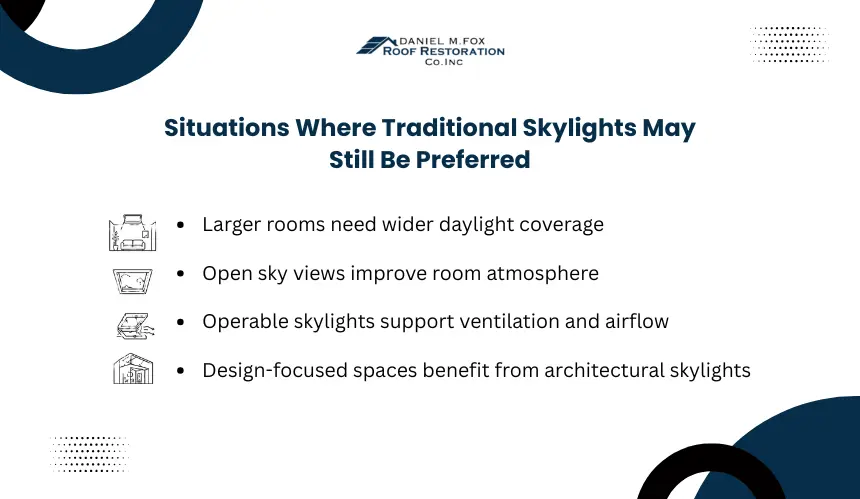
While tubular systems optimize efficiency in tight spaces, traditional skylights offer advantages in scenarios where visual openness and higher light volume are required. Their performance aligns better with design-driven or multi-functional spaces.
1. Rooms Needing Expansive Daylight And Outdoor Views
Traditional skylights create a direct visual connection to the sky, which adds depth and openness to a room. In spaces where natural views contribute to comfort or ambiance, tubular systems cannot replicate this effect since they only transmit light without visibility.
2. Larger Spaces Where Light Spread Must Cover Wider Areas
In rooms that extend beyond compact dimensions, a single tubular unit may not provide sufficient coverage. Traditional skylights, with larger glazing areas, allow more daylight to enter and spread across a broader surface, reducing the need for multiple installations.
3. Design-Focused Applications Prioritizing Aesthetics
Architectural designs that emphasize natural light as a visual feature often rely on traditional skylights. Their size, shape variations, and placement flexibility allow them to function as both a lighting source and a design element, enhancing the overall interior layout.
4. Ventilated Skylight Needs For Airflow And Temperature Control
Operable traditional skylights can be opened to release trapped heat and improve air circulation. This dual functionality supports passive cooling strategies, especially in rooms where airflow is limited. Tubular skylights are sealed systems and do not provide ventilation, which limits their role to lighting only.
Which Skylights Work Better In South Shore And Greater Boston Conditions
Massachusetts homes often face mixed weather patterns, including freeze-thaw cycles, coastal moisture, heavy rain, snow load, and humid summers. In South Shore towns, salt air and wind-driven rain make skylight installation more sensitive to flashing quality and roof sealing, while older Greater Boston homes may have tighter attic layouts, steeper roofs, and limited framing flexibility.
For small rooms, tubular skylights are often the more practical choice because they require smaller roof openings and reduce the amount of exposed glazing. This can lower the risk of heat loss during colder months and limit unwanted solar gain in summer. They also work well in bathrooms, hallways, closets, and interior rooms where direct sky views are less important than steady daylight.
Traditional skylights may still be preferred in larger rooms, finished attics, stairwells, or renovated living spaces where visual openness, ventilation, or architectural character matters. In coastal and older urban homes, proper flashing, insulated glazing, and professional roof integration become critical to prevent condensation, leaks, and seasonal energy loss.
Choosing the right skylight isn’t just about light, it’s about performance, efficiency, and long-term reliability. If you’re planning an upgrade or evaluating options for your space, Daniel Fox Roofing can help you assess what actually works for your home’s structure and local conditions. Get expert guidance and make the right choice the first time.
Frequently Asked Questions
Do tubular skylights make small rooms too bright?
Tubular skylights usually provide softened daylight rather than harsh direct glare because the ceiling diffuser spreads light before it enters the room. In very small bathrooms or closets, diffuser size, tube diameter, and roof orientation affect brightness. A properly sized unit can brighten the space without making it feel overexposed.
Can a tubular skylight work if the room is not directly under the roof?
A tubular skylight can often serve rooms that are not perfectly aligned with the roof opening because reflective tubing can be angled through attic space. Performance depends on tube length, number of bends, and reflective quality. Shorter, straighter tube paths usually deliver stronger daylight and better efficiency.
Are traditional skylights more likely to leak than tubular skylights?
Leak risk depends more on installation quality, flashing, roof pitch, and roofing material than the skylight type alone. Traditional skylights have larger roof openings and more perimeter flashing, so mistakes can create greater exposure. Tubular skylights reduce roof penetration size, but they still require correct sealing and weatherproofing.
Which skylight is better for a bathroom with moisture and humidity?
A tubular skylight is often practical for small bathrooms because it adds daylight without introducing a large glass surface where condensation may become more noticeable. Bathrooms still need proper exhaust ventilation. For larger bathrooms where airflow is a priority, an operable traditional skylight may offer added ventilation benefits.
Will a skylight increase heating or cooling costs in a small room?
Energy impact depends on glazing, insulation, orientation, air sealing, and room size. Tubular skylights usually have lower thermal impact because they expose less roof surface and transmit daylight through a sealed tube. Traditional skylights can affect temperature more, especially if the unit is oversized or poorly insulated.
How should homeowners choose between tubular and traditional skylights in older Massachusetts homes?
Older homes in Greater Boston and the South Shore often have tight roof framing, finished attic areas, and weather-sensitive roofing details. Tubular skylights may be easier to fit into restricted layouts. Traditional skylights can still work well when the roof structure supports larger openings and the goal includes views, ventilation, or architectural character.