
- danielfox
How Roofing Documentation Supports Historic Registry Applications
Did you know? Roofing documentation supports historic registry applications by providing verifiable evidence of a building’s original roof materials, construction era, and preservation history. Review boards depend on these records to confirm that the roof still reflects its period-appropriate design, craftsmanship, and structural form. Without accurate roofing documentation, evaluators cannot fully assess whether a property retains the architectural integrity required for historic designation. |
Many applicants only realize the importance of these details when they begin gathering their submission materials. Missing repair logs, unverified replacements, incomplete photographs, or undocumented alterations can introduce uncertainty into the evaluation process.
Since the roof is one of the strongest indicators of historical character, these records help historic roof preservation specialists understand how much of the structure remains authentic and how closely it aligns with documented historical descriptions.
Understanding the Role of Roofing in Historic Registry Evaluation
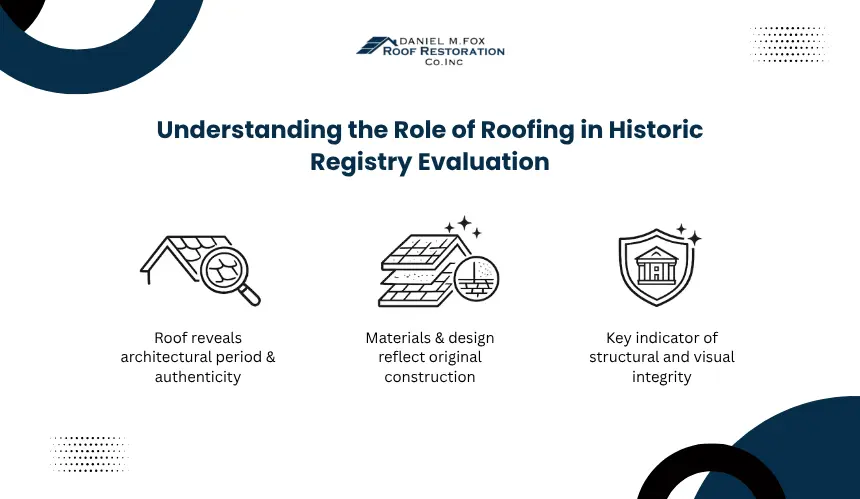
Historic preservation teams evaluate roofs because they reveal how closely a property aligns with its original architectural period. A roof’s materials, profile, and construction history provide measurable indicators of authenticity. These details help determine whether a building still possesses the visual and structural qualities required for historic recognition.
Understanding the Role of Roofing in Historic Registry Evaluation
Historic preservation teams study the roof because it carries architectural clues that help determine when the building was constructed and how closely it aligns with its documented style. The roof often preserves details that remain stable over time, which makes it a reliable reference point during historic evaluations.
- Roofing features such as pitch, tile patterns, metal edging, and overall roofline help reviewers identify the structure’s architectural period.
- Material traits like slate type, cedar grain, or handcrafted metal elements reflect the craftsmanship of the original build and show how well the structure has been preserved.
- Alterations to the roof, including changes in shape, covering material, or structural form, influence how closely the property aligns with its original design. Reviewers assess these changes to determine whether the building still retains its required architectural integrity.
Types of Roofing Documentation Required for Historic Registry Applications
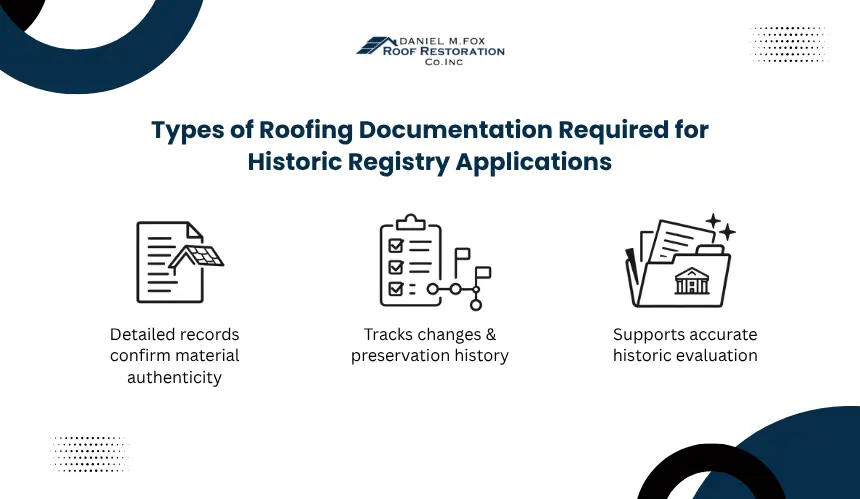
Applicants preparing for a historic registry submission are often surprised by how detailed the roofing documentation must be. Preservation offices rely on precise records to confirm authenticity, evaluate material continuity, and understand how the roof has changed over time.
What Material Records Are Needed to Verify Roofing Authenticity
Material records help reviewers determine whether the current roof matches the building’s original construction period. These documents may include manufacturer information, historic invoices, quarry sources for slate, species identification for cedar, or archival notes about early metalwork.
When applicants provide accurate material histories, preservation teams can compare these details with known architectural standards for the building’s era.
What Installation and Repair Logs Are Required to Show Preservation History
Installation dates, contractor records, and repair logs show how the roof has been maintained across decades. These documents help evaluators judge whether past work respected the building’s original design or introduced changes that could influence eligibility. A consistent maintenance trail also demonstrates stewardship, which is often valued in historic evaluations.
Why Photographs and Condition Reports Matter in Roof Preservation History
Photographs and condition reports provide visual and technical confirmation of the roof’s current state. Reviewers use these images and assessments to identify material wear, structural behavior, and any visible modifications.
Clear photographs taken from multiple angles help connect written documentation with actual conditions, while condition reports offer a professional interpretation of the roof’s stability and authenticity.
How Roofing Documentation Strengthens a Historic Registry Application
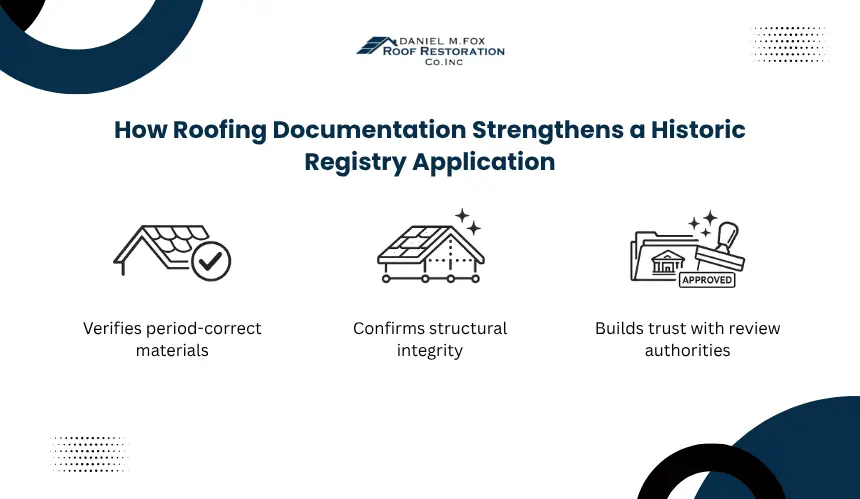
Roofing documentation becomes a deciding factor during historic evaluations because it allows reviewers to verify architectural truth rather than rely on assumptions or incomplete descriptions. Each document adds a layer of clarity that helps determine whether the building still reflects its original form and craftsmanship.
How Roofing Documentation Proves Material Authenticity and Period Accuracy of Your Property
Historic review boards compare roofing materials with established architectural records for the building’s era. Documentation showing original slate types, early copperwork, or traditional cedar profiles helps confirm that the roof still matches its historical period.
Clear evidence of period-accurate materials gives evaluators confidence that the property has retained a core part of its architectural identity, which is essential for eligibility.
How Roof Structural Records Support Integrity Claims
Structural records provide insight into the roof’s framework, load behavior, and long-term performance. Engineering notes, framing diagrams, and stability assessments help reviewers understand whether the underlying roof structure still matches the original design.
These records prove that the roof has not undergone major structural alterations that could compromise historic integrity.
Key Agencies That Rely on Roofing Documentation
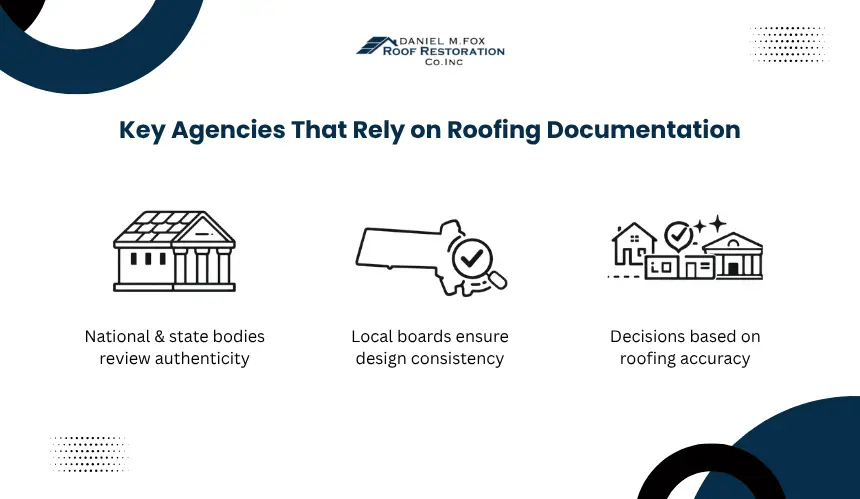
Multiple preservation agencies review roofing documentation to determine whether a property qualifies for historic recognition. Each agency evaluates different aspects of the roof, from architectural accuracy to material continuity, and these assessments often influence the final eligibility decision.
How the National Park Service Uses Roofing Documentation in Federal Reviews
The National Park Service evaluates roofing details to determine whether a structure meets the criteria for inclusion in the National Register of Historic Places.
Reviewers study roof shape, material type, craftsmanship indicators, and overall design consistency to confirm whether the property reflects the period in which it was built.
Roofing evidence helps the agency assess integrity, which is a major requirement for federal-level recognition. Clear documentation allows NPS staff to compare current conditions with archival descriptions and establish the historical reliability of the structure.
How the Massachusetts State Historic Preservation Office Assesses Roofing Authenticity
The Massachusetts State Historic Preservation Office examines roofing documentation to understand how well a property has preserved its historical character at the state level.
SHPO reviewers analyze original material traits, evidence of traditional construction methods, and any visible changes that may have influenced the roof’s evolution.
These assessments help determine whether the structure still reflects the defining qualities of its architectural style and whether past repairs align with preservation expectations in Massachusetts.
How Local Preservation Commissions in Massachusetts Evaluate Roofing Features
Local preservation commissions across Massachusetts rely on roofing evidence to ensure compliance with district guidelines that protect community heritage.
These boards focus on elements such as roofline configuration, surface materials, and exterior modifications because they influence the visual consistency of historic neighborhoods.
Roofing documentation helps them determine whether a property contributes positively to the district’s character and whether any previous alterations are compatible with local preservation standards.
Tools, Methods, and Technology Used to Document Historic Roofing
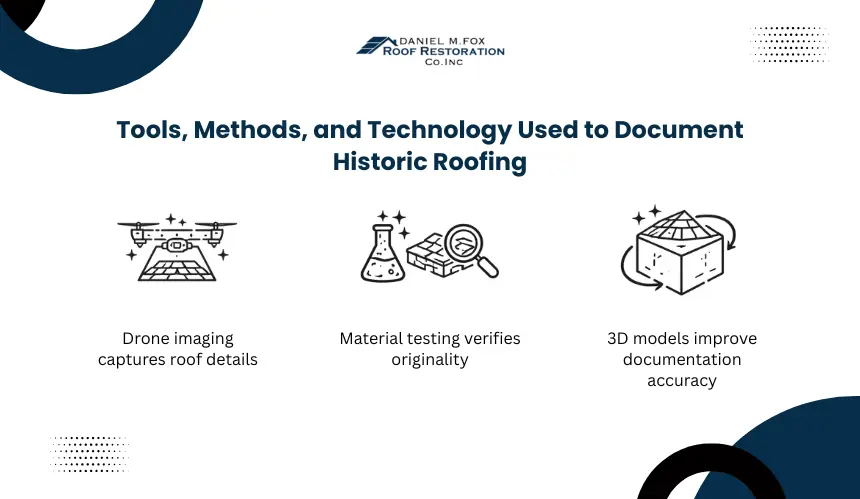
Accurate roofing documentation depends on reliable methods that capture material details, structural conditions, and long-term behavior. Preservation teams in Massachusetts and across the country use a combination of modern technology and traditional assessment techniques to create records that meet historic registry requirements.
How Drones and Aerial Mapping Capture Accurate Roof Details
Drone-based imaging allows specialists to photograph hard-to-reach areas without disturbing fragile historic materials. High-resolution aerial images show rooflines, surface textures, flashing conditions, and overall patterns of wear.
These visuals help reviewers understand design elements that support architectural dating. Aerial mapping also produces precise measurements that strengthen the accuracy of documentation submitted with registry applications.
How Material Sampling and Laboratory Testing Identify Original Roofing Components
Material samples are sometimes collected to determine the age and composition of roofing elements. Slate flakes, wood segments, and metal fragments are analyzed to identify quarry origins, species types, manufacturing marks, and historical fabrication techniques.
Laboratory testing helps verify whether the roof retains components from its original construction period, which is essential for proving authenticity in Massachusetts preservation reviews.
How 3D Modeling and Digital Archiving Strengthen Documentation Accuracy
Digital modeling tools help create highly detailed representations of a historic roof. Preservation specialists use these models to record dimensions, framing patterns, and material placement in a format that can be easily reviewed by agencies.
Digital archives also store long-term documentation, which helps track changes over time and provides a clear timeline for future restoration efforts.
When to Hire a Roofing Preservation Contractor
Some historic properties require professional guidance to gather accurate roofing documentation. Specialists help uncover missing information, interpret aging materials, and verify construction details that support a strong historic registry submission.
- Hire a roofing historian when the property has limited records or unclear construction origins. They help identify period-specific materials and architectural traits that evaluators look for.
- Work with a preservation consultant when the building has undergone multiple repairs. These experts trace changes, analyze compatibility with historic standards, and prepare documentation that aligns with Massachusetts preservation criteria.
- Choose a specialized contractor when the roof needs repairs that must match traditional construction methods. Their experience helps preserve authenticity while ensuring the structure remains stable.
If your property needs expert guidance, Daniel Fox Roofing Inc. can help you navigate roofing assessments with accuracy and care. Reach out today to ensure your historic application starts with the strongest roofing documentation possible.
Frequently Asked Questions
Can digital property archives improve future historic registry submissions?
Yes. Digital archives preserve roofing records, photographs, and inspection notes in a stable format that can be accessed during future evaluations. This prevents data loss and helps maintain a long-term preservation trail that supports future reviews or restoration planning.
Do weather-related roofing issues affect how historic reviewers view a property?
Weather damage does not automatically harm eligibility, but reviewers may look for signs of recurring issues that impact the building’s long-term stability. Applicants who document seasonal wear patterns often provide helpful context that strengthens their submission.
How important is it to document the craftsmanship techniques used in older roofs?
Craftsmanship details help show how the roof was originally assembled. Techniques such as hand-cut slate preparation or traditional copper seam work provide authentic indicators of the building’s construction period and can support broader architectural research.
Are there benefits to submitting ongoing maintenance logs with a historic application?
Ongoing maintenance logs show consistent care and can help reviewers understand how the property has been preserved over time. They also demonstrate responsibility on the part of the owner, which supports trust in future restoration decisions.
How early should roofing evaluations begin before submitting a historic application?
Early evaluations are recommended so applicants have time to address missing records, gather additional evidence, or complete visual assessments. Starting early also helps avoid delays related to seasonal conditions or specialist availability.