
- danielfox
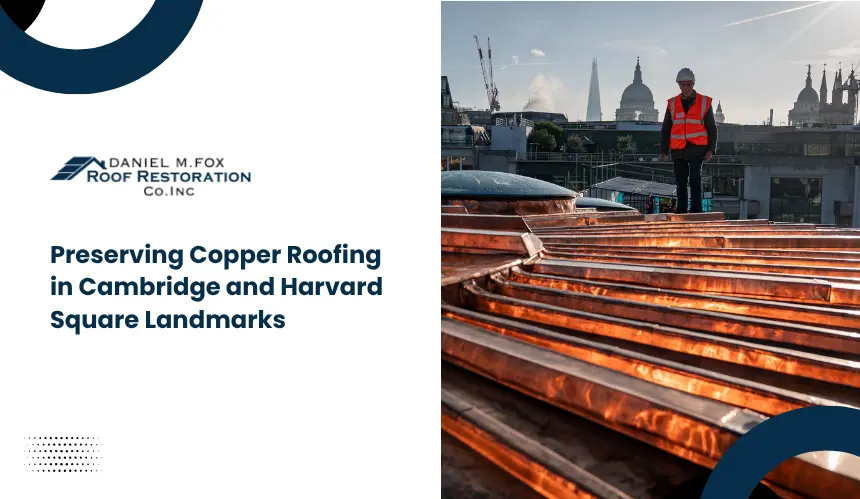
Preserving Copper Roofing in Cambridge and Harvard Square Landmarks
Key Takeaways
|
In a city where more than 3,100 buildings are protected under local preservation controls, even a copper roof repair is rarely a routine roofing decision. Copper roofing across historic properties in Cambridge and Harvard Square faces a precise challenge: preserving structural performance without disrupting architectural authenticity.
Standard roofing repairs fail here because historic materials, installation methods, and preservation requirements limit intervention options. This blog explains the key issues affecting copper roofs in these districts and the methods used to preserve them correctly.
Why Copper Roofing Requires Specialized Preservation in Historic Landmarks
Copper roofing in Cambridge and Harvard Square operates within a tightly controlled environment where material behavior, historical significance, and regulatory oversight intersect. Preservation is not simply about maintaining performance, but about doing so without altering structural identity or violating conservation standards.
Environmental Exposure In Cambridge’s Urban Microclimate
Copper roofing systems in this region are continuously subjected to moisture cycles, temperature variation, and airborne pollutants. These conditions influence how the material responds over time, particularly in how surface reactions develop across different exposure zones. Variations in sunlight, runoff paths, and surrounding structures create uneven stress distribution, which directly affects long-term material stability.
Architectural Significance Of Copper In Harvard Square Properties
In Harvard Square, copper roofing is integrated into the architectural language of landmark buildings. Its form, joint configuration, and surface evolution are part of the original design intent. Preservation efforts must therefore maintain these characteristics precisely, as even minor
deviations in panel geometry or seam detailing can compromise historical authenticity and visual continuity.
Regulatory Constraints In Landmark Preservation Zones
All restoration activity is subject to strict review under local historic preservation frameworks that enforce adherence to original construction methods and material integrity.
Any intervention must demonstrate that it preserves both functional performance and historical accuracy, limiting the use of modern modifications and requiring technically precise execution aligned with documented standards.
Common Deterioration Issues Affecting Aging Copper Roof Systems
As copper roofing systems age, degradation emerges through structural and mechanical stress rather than isolated surface changes. These issues develop within joints, connections, and support systems, ultimately affecting the roof’s ability to remain watertight and structurally stable.
Surface Instability Leading To Localized Material Degradation
Once the protective surface layer loses uniformity, exposed areas begin to experience accelerated wear. This does not occur uniformly across the roof. Instead, vulnerable zones develop where environmental stress concentrates, leading to thinning, pitting, and reduced resistance to further degradation. These localized weaknesses often precede visible failure.
Seam Fatigue Caused By Repeated Thermal Cycling
Copper’s continuous expansion and contraction place cumulative stress on seams and soldered joints. Over time, this movement reduces joint flexibility and increases the likelihood of micro-separation. These separations create entry points for moisture, shifting the risk from surface exposure to internal infiltration along connection lines.
Electrochemical Damage From Material Incompatibility
When copper interfaces with dissimilar metals or is exposed to chemically reactive runoff, electrochemical reactions initiate material breakdown. This process weakens specific sections of the roofing system rather than the entire surface, making damage more difficult to detect and often more severe in isolated areas.
Structural Movement Due To Fastener And Substrate Failure
Hidden support components, including fasteners and underlying substrates, degrade due to prolonged exposure to moisture and load stress. As these elements lose integrity, the copper panels begin to shift or deform. This movement increases strain on seams and connections, compounding structural vulnerability even if the outer surface appears intact..
Proven Techniques Used In Copper Roof Preservation And Restoration
Effective preservation depends on selecting interventions that stabilize the system without altering its original construction logic. In Cambridge and Harvard Square landmarks, techniques must address specific failure points while maintaining historical accuracy and long-term performance.
When Is Selective Panel Replacement Preferable To Full Restoration?
Targeted panel replacement is used when deterioration is confined to isolated sections and the surrounding system remains structurally stable. Removing only compromised panels preserves the majority of the original installation, reducing disruption to seam networks and adjacent materials.
This approach also limits regulatory complexity, as partial interventions are often easier to align with preservation requirements when original detailing is retained.
How Are Seams And Joints Reinforced Without Altering Original Design?
Seam reinforcement focuses on restoring joint integrity rather than replacing entire sections. Techniques include precision re-soldering and mechanical tightening of standing seams to eliminate separation points.
The objective is to re-establish watertight continuity while preserving original seam geometry, ensuring that repairs remain visually and structurally consistent with the existing roof system.
What Methods Are Used To Stabilize The Copper Surface Without Over-Treatment?
Surface intervention is limited to controlled cleaning and stabilization processes that remove harmful deposits without disturbing the existing protective layer. Abrasive or aggressive treatments are avoided because they accelerate future degradation.
Instead, preservation strategies focus on maintaining surface equilibrium, allowing the material to continue its natural protective behavior without artificial alteration.
When Are Protective Coatings Or Modern Treatments Justified?
Modern coatings are applied only in cases where environmental exposure or prior damage has compromised the roof’s ability to self-stabilize. Even then, coatings must be vapor-permeable and visually compatible with historic finishes.
In regulated areas, their use requires justification and approval, as inappropriate applications can trap moisture, alter appearance, and conflict with preservation standards.
How Preservation Strategies Must Align With Cambridge Historic Guidelines
Preservation work in Cambridge and Harvard Square is not executed solely on technical merit. Every intervention must be validated against regulatory expectations that prioritize historical continuity over modern efficiency.
All proposed work is reviewed by the Cambridge Historical Commission before execution. Submissions typically require detailed scope definitions, material specifications, and visual documentation of existing conditions. Approval depends on demonstrating that the intervention will not alter the building’s historical character or introduce incompatible methods.
Preservation decisions in Cambridge are shaped by a wider regulatory landscape that spans two historic districts and four neighborhood conservation districts, which is why material changes are scrutinized closely rather than treated like standard roof replacement work.
Why Must Original Fabrication Methods Be Replicated in Historic Roofs?
Historic copper roofs were constructed using specific forming, joining, and fastening techniques that define both their performance and appearance. Preservation strategies must replicate these fabrication methods to maintain system compatibility.
Deviating from original techniques can introduce stress inconsistencies, reduce longevity, and create visual discrepancies that conflict with landmark standards.
What Limits Exist On Introducing Modern Materials Or Modifications to Historic Roofs?
Modern materials are restricted when they alter visual elements or behave differently under environmental stress. For example, introducing alternative metals, synthetic sealants, or non-traditional coatings can disrupt the interaction between components within the roof system.
Regulatory frameworks prioritize material continuity, meaning any substitution must match both the physical properties and visual outcome of the original installation.
How Do Compliance Requirements Influence Project Execution Timelines?
Regulatory oversight introduces additional stages in project planning, including documentation, review cycles, and revision requests. This extends timelines compared to standard roofing projects, particularly when working within densely regulated zones like Harvard Square.
Delays are not procedural inefficiencies but necessary controls to ensure that preservation outcomes align with historical and architectural standards.
Long-Term Maintenance Practices That Extend Copper Roof Lifespan
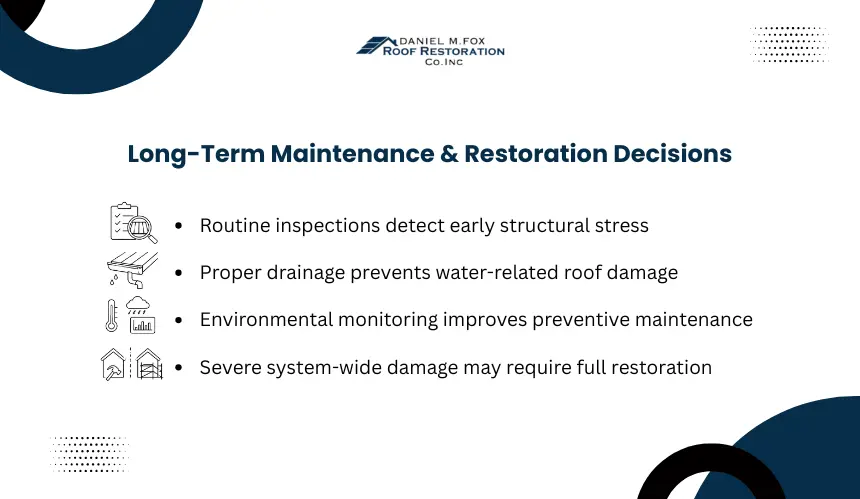
Preservation does not end after restoration. Long-term performance depends on controlled maintenance practices that prevent minor stress points from evolving into structural failures, especially in dense urban environments like Cambridge and Harvard Square.
Scheduled Inspections Prevent System-Level Failures
Routine inspections focus on identifying early-stage movement, joint stress, and drainage inefficiencies before they compromise system integrity. Instead of reacting to visible damage, inspections track subtle changes such as seam displacement or panel distortion, allowing corrective action to be taken before water infiltration or structural strain develops.
Drainage Control Critical For Copper Roof Stability
Water flow management directly influences how stress is distributed across the roof system. Blocked or inefficient drainage leads to localized water retention, increasing load pressure and accelerating wear at connection points.
In older Cambridge properties, where roof geometry may not meet modern drainage standards, maintaining clear pathways becomes essential for preventing long-term structural imbalance.
What Risks Arise From Improper Repairs And Maintenance Practices?
Incorrect interventions, such as using incompatible sealants or applying non-permeable coatings, disrupt how the roof manages moisture and thermal movement. These actions often create concealed damage by trapping moisture or restricting natural expansion, leading to accelerated failure within seams and support components rather than on the visible surface.
Environmental Monitoring Support Preventive Maintenance
Tracking exposure conditions such as moisture levels, pollutant accumulation, and seasonal temperature variation allows maintenance strategies to be adjusted proactively.
In areas like Harvard Square, where surrounding infrastructure influences airflow and runoff patterns, environmental monitoring helps identify zones that require more frequent attention, reducing uneven stress distribution across the system.
Copper roofs in Cambridge operate under persistent moisture loading, and nearby Boston climate normals show about 42.26 inches of annual precipitation and 49.2 inches of annual snowfall, which reinforces the need for seam stability and drainage control over time, based on NOAA climate data.
When To Repair Vs Fully Restore A Copper Roof In Landmark Properties
The decision depends on whether deterioration is localized or system-wide, and whether the existing structure can maintain performance without compromising historical integrity.
Repair is preferred if:
- Damage is confined to specific panels, seams, or connection points
- Structural anchoring and substrate remain stable
- Moisture infiltration is minimal and traceable to isolated areas
- Original fabrication and the majority of materials are still intact
- Compliance requirements favor minimal intervention
Full restoration is preferred if:
- Degradation affects multiple sections across the roof system
- Seam networks show widespread fatigue or recurring separation
- Underlying support systems or fasteners have deteriorated
- Water intrusion is systemic rather than localized
- Previous repairs have introduced incompatible materials or recurring failure points
Frequently Asked Questions
How early should a copper roof project be planned in Harvard Square?
Start earlier than a standard reroofing job. In the Harvard Square Conservation District, projects are reviewed at monthly public meetings, and work on protected properties cannot begin until the required certificate is issued. That makes early condition documentation, scope definition, and preservation review part of the project timeline, not an afterthought.
Can new copper be made to match an older landmark roof?
Matching is possible, but it is rarely instant. Copper’s weathering cycle depends on moisture, slope, orientation, and local atmospheric conditions, so adjacent new panels can age differently for years. Pre-patinated or chemically colored copper can reduce visual contrast, but the final appearance still needs to align with the building’s historic character and exposure pattern.
What kind of contractor should handle a historic copper roof?
A general roofer is often not enough. Historic copper work usually calls for a contractor experienced in architectural sheet metal, traditional seam detailing, and preservation documentation.
That is a practical consequence of two facts: protected Cambridge properties require formal review, and preservation standards emphasize repair methods consistent with historic character rather than generic replacement practices.
Does every visible copper roof repair need formal historic review?
Not always at the same level, but owners should never assume visible exterior work is exempt. Cambridge notes that some repairs in kind may be approved administratively by staff, while protected-property work generally requires a certificate before work starts.
The deciding factor is usually the property designation, visibility, and whether the repair changes material, profile, or appearance.
Is preserving copper still worth it when cheaper roofing options exist?
For landmark properties, the decision is usually driven by life-cycle value and historical fit, not just first cost. Copper roofs are widely estimated to last more than 100 years when properly designed and installed, and preservation guidance generally favors retaining significant historic fabric when viable. Lower-cost substitutes can reduce authenticity and complicate approvals.
What should an owner document before requesting preservation estimates?
Good documentation shortens both pricing and review. Capture close photos of seams, flashings, gutters, staining patterns, interior leak locations, past patch repairs, and any areas that hold snow or standing water.
On protected Cambridge properties, that record helps contractors build a preservation-minded scope and supports the review process with clearer existing-condition evidence.