
- danielfox
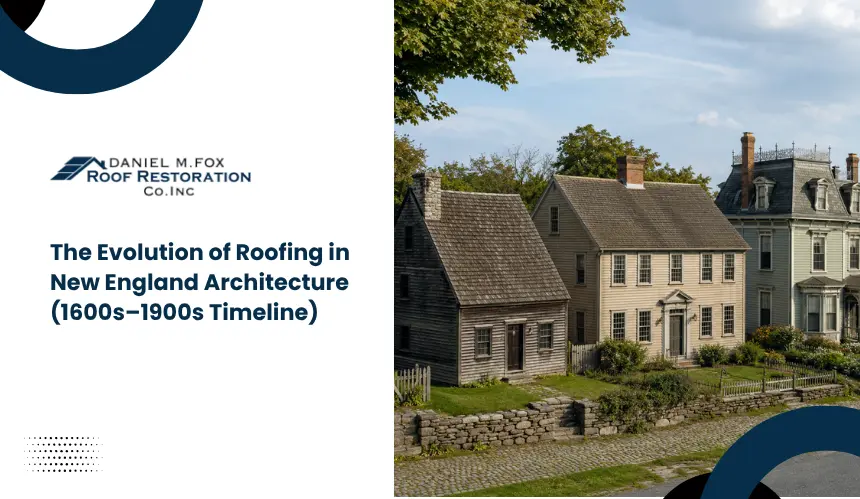
The Evolution of Roofing in New England Architecture (1600s–1900s Timeline)
Key Takeaways
|
Roofing in New England was never a static design choice. Builders had to respond to extreme winters, coastal exposure, fire risks, and shifting material availability, forcing continuous adaptation over centuries. What appears today as traditional architecture is actually the result of layered decisions driven by climate stress, technological limits, and economic access.
Without understanding this progression, modern interpretations often miss why certain roof forms and materials still perform better in this region. This blog breaks down how roofing systems evolved from the 1600s to the 1900s and what factors shaped those changes.
How Climate and Settlement Conditions Shaped Early Roofing (1600s–1700s)
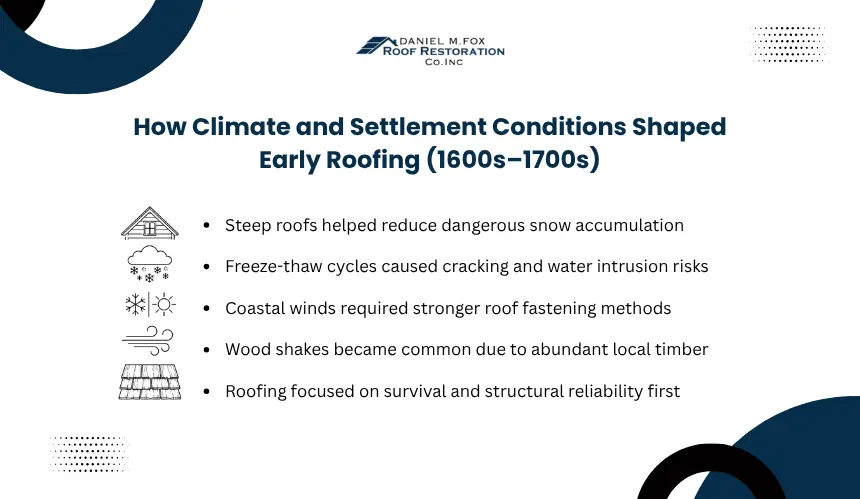
Early roofing in New England was engineered under constraint rather than choice. Builders prioritized structural survival against climate exposure and limited resources, resulting in forms and materials that directly responded to environmental pressure.
Harsh New England Weather as a Structural Constraint
Heavy snowfall created continuous load stress, forcing the adoption of steep roof pitches to accelerate snow shedding and prevent structural collapse. Freeze-thaw cycles introduced expansion and contraction in roofing materials, increasing the risk of cracking and water infiltration.
Coastal regions added wind uplift pressure, requiring tighter fastening methods even in rudimentary construction. These conditions made low-slope or flat roofing impractical, establishing pitched gable roofs as a functional standard rather than an aesthetic preference.
Locally Available Materials and Their Limitations
Colonial builders relied on locally sourced timber due to its abundance and ease of processing. Wood shakes and hand-split shingles became the dominant roofing materials, offering moderate water resistance but limited longevity under constant moisture exposure.
Thatch was occasionally used in early settlements but declined quickly due to fire risk and poor durability in wet, cold climates. The absence of industrial processing meant material consistency varied, leading to uneven performance across structures.
Early Colonial Roofing Designs and Their Functionality
Early construction focused on speed, labor efficiency, and structural reliability. The gable roof became the default configuration because it required minimal structural complexity while providing effective water runoff.
English architectural influence introduced familiar building patterns, but these were simplified to match available tools and environmental demands.
Decorative elements were largely absent, as roofing systems were evaluated on their ability to withstand seasonal stress rather than on their visual appeal.
Transition To Standardized Wood Shingles And Improved Craftsmanship in New England (1700s–Early 1800s)
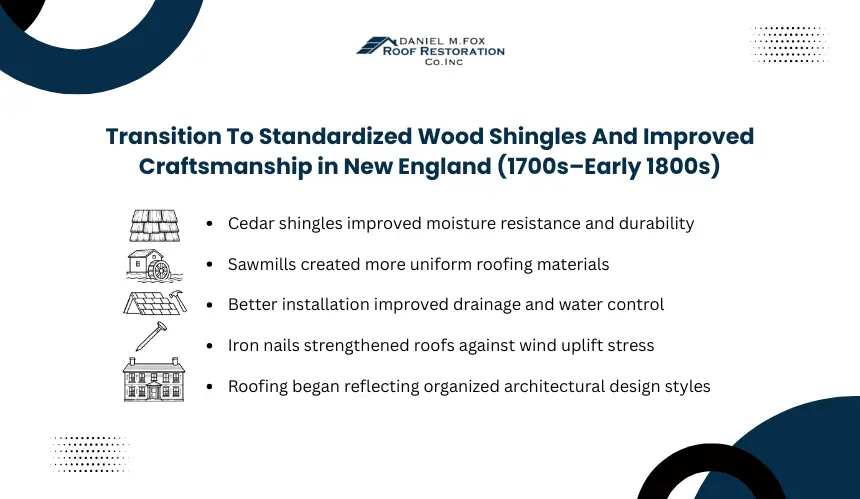
As settlements stabilized and local industries developed, roofing shifted from survival-driven construction to more controlled and repeatable methods. Improvements in material processing and workmanship increased roof lifespan and consistency across structures.
Emergence of Cedar Shingles as a Dominant Material
Cedar offered a performance advantage due to its natural oils, which resist moisture absorption and slow biological decay. Compared to earlier wood shakes, cedar shingles provided tighter overlap and better surface uniformity, reducing water penetration during prolonged rainfall and snowmelt.
The material also maintained dimensional stability under temperature variation, lowering the rate of warping and splitting. These properties made cedar a practical long-term solution in regions with persistent humidity and seasonal extremes.
Advancements in Roofing Tools and Installation Techniques
The expansion of water-powered sawmills enabled the production of uniformly cut shingles, replacing inconsistent hand-split materials. This uniformity improved installation precision, allowing tighter joints and more predictable water runoff behavior.
Iron nails began to replace wooden pegs, increasing fastening strength and resistance to wind uplift. As a result, roofs required less frequent repair and demonstrated improved structural reliability under repeated environmental stress.
Architectural Influence on Roofing Aesthetics
With increased material reliability, roof construction began aligning with emerging architectural standards such as Georgian and Federal styles. These styles introduced proportional symmetry and refined rooflines, shifting roofing from purely functional to structurally organized design.
Pitch angles became more consistent across buildings, and eave detailing improved drainage control at roof edges. Roofing started to reflect both performance requirements and architectural coherence within expanding towns and settlements.
Industrialization And The Introduction Of New Roofing Materials in New England (Mid-1800s)
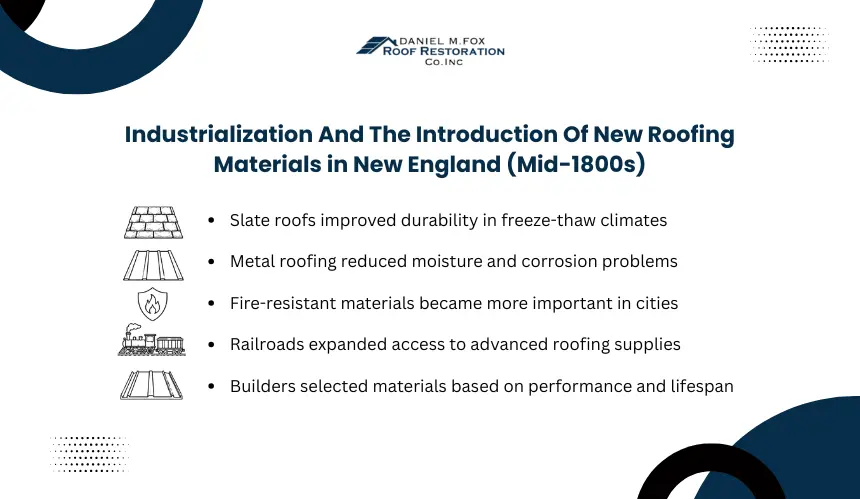
Industrial expansion shifted roofing from locally constrained systems to performance-driven material selection. Mechanized production, improved logistics, and urban fire risks pushed builders toward materials that delivered longer service life and higher structural reliability.
Rise Of Slate Roofing In Urban And Affluent Areas
Slate roofing gained traction in established communities where long-term durability justified a higher upfront cost. Its dense composition minimized water absorption, reducing cracking under repeated freeze-thaw cycles common across towns like Cambridge and Brookline.
Unlike wood, slate provided inherent fire resistance, which became critical after multiple 19th-century urban fires influenced building practices. Access to northeastern quarries, combined with improved cutting and grading methods, enabled consistent installation standards and extended roof lifespans well beyond traditional materials.
Metal Roofing And Its Functional Advantages
Metal roofing introduced a lightweight alternative that balanced durability with faster installation. Tin-coated iron reduced corrosion exposure while maintaining structural strength, making it practical for both residential and commercial structures.
Copper was often selected for institutional buildings due to its resistance to moisture and its ability to form a protective surface layer over time. In areas closer to coastal influence or high-humidity zones, metal roofing reduced maintenance cycles compared to wood-based systems. Its continuous sheet format also improved drainage efficiency during heavy rainfall events.
Impact Of Railroads On Material Distribution
Railroad expansion removed the dependency on hyper-local materials, allowing roofing supplies to move efficiently between production regions and growing towns such as Newton and Watertown. This logistical shift enabled consistent access to slate, metal sheets, and prefabricated components, reducing variability in construction quality.
Builders could now select materials based on performance rather than availability, which accelerated the adoption of standardized roofing systems. As distribution networks matured, pricing stabilized, making advanced roofing materials accessible beyond elite properties.
Late 19th Century Roofing Innovations And Architectural Diversity
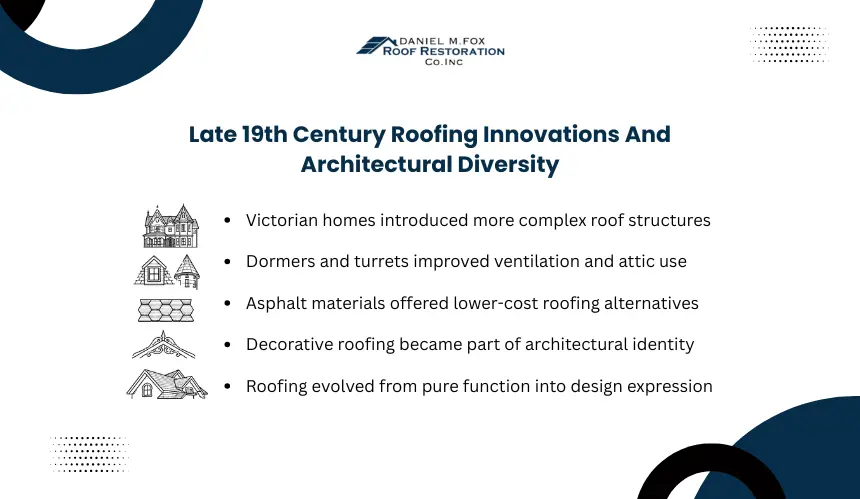
By the late 1800s, roofing systems were no longer limited by material access or basic structural needs. Design complexity increased as architectural styles evolved, and roofing began integrating both performance and visual identity.
Victorian Architecture And Complex Roof Structures
Victorian-era construction introduced multi-dimensional roof forms that went beyond simple gable layouts. Features such as dormers, turrets, intersecting rooflines, and steep variations in pitch increased both functional coverage and architectural character.
These complex geometries improved attic ventilation and interior space utilization but required more precise framing and load distribution. In established areas like Newton and Concord, many preserved homes still reflect these intricate roof configurations, demonstrating the shift toward design-driven construction.
Asphalt-Based Materials Begin To Emerge
Asphalt roofing materials began appearing in the late 19th century as a lower-cost alternative to slate and metal. Early versions were manufactured by saturating organic materials like felt with bitumen, creating a water-resistant surface layer. While initial durability was lower than slate, asphalt shingles roofing offered easier installation and reduced labor requirements.
This made them practical for expanding residential developments where cost efficiency influenced material selection. Their adaptability laid the foundation for the widespread use of asphalt shingles in the 20th century.
Roofing As Both Function And Design Statement
Roofing transitioned into a visible architectural feature rather than a purely protective layer. Material choice, color variation, and structural detailing began aligning with overall building aesthetics. Decorative elements such as patterned shingles, ornamental ridge caps, and varied roof heights contributed to a more expressive design language.
This shift reflected broader architectural trends where exterior appearance carried social and economic signaling, especially in growing suburban communities across the New England region.
What Historical Roofing Evolution Reveals For Modern Architecture in New England
Historical roofing patterns in New England continue to inform modern design decisions, particularly in regions where climate performance and structural reliability remain critical. Past material transitions and design choices provide a tested framework for evaluating current roofing systems.
Why Steep Roof Designs Still Matter In Cold Climates
Steep roof pitches remain structurally relevant because they reduce snow accumulation and minimize prolonged load stress on framing systems.
In climates similar to those experienced across towns like Weston and Wayland, rapid snow shedding lowers the risk of ice dam formation and water intrusion at roof edges.
This design approach also improves drainage efficiency during seasonal transitions, reducing moisture retention that can degrade roofing materials over time.
Material Evolution As A Blueprint For Modern Durability
Modern roofing systems reflect direct improvements on historical materials rather than complete replacements. Asphalt shingles evolved from early bitumen-based products, offering improved layering, weather resistance, and ease of installation.
Metal roofing systems now incorporate advanced coatings to prevent corrosion, extending service life in high-moisture environments. Even contemporary composite materials are engineered to replicate the durability characteristics of slate while reducing structural load requirements.
Preservation Vs. Modernization In New England Homes
Property owners across areas such as Arlington and Winchester often face a trade-off between maintaining historical authenticity and upgrading performance.
Preservation efforts prioritize original materials like wood or slate to retain architectural value, especially in historically designated districts. Modernization introduces engineered materials that improve insulation, moisture resistance, and maintenance cycles.
Effective decision-making requires balancing historical integrity with long-term performance outcomes, particularly in structures exposed to consistent environmental stress.
Roofing decisions in New England demand more than basic installation knowledge. They require an understanding of climate performance, material behavior, and structural longevity built over centuries. Daniel Fox Roofing applies that level of insight to every project, helping property owners make roofing choices that hold up against real environmental conditions. Connect with the team to evaluate your roof with a historically informed, performance-first approach.
Frequently Asked Questions
How can someone tell whether a New England home originally had wood shingles, slate, or metal roofing?
Original roofing clues usually appear in the roof framing, nail patterns, sheathing thickness, and surviving trim details. Slate often required heavier structural support, while wood shingles were paired with lighter framing. Historic photos, tax records, and restoration reports can also reveal whether the roof material was changed during later renovations.
Why do so many historic New England homes still avoid low-slope roofing designs?
Traditional New England construction evolved around snow shedding, drainage control, and freeze-thaw durability. Low-slope roofs hold moisture longer, increase ice dam risk, and place more stress on waterproofing layers in cold climates. Even when modern membranes improve performance, many historic homes still perform better with pitched roof geometry.
Does replacing original slate with asphalt affect the value or character of a historic property?
Material substitution can change both architectural authenticity and long-term perception of the property. Slate carries visual depth, profile variation, and historical accuracy that asphalt usually cannot replicate. In preservation-sensitive neighborhoods, replacing slate with asphalt may reduce heritage value, even if the newer system lowers installation cost and structural load.
What hidden structural problems show up when restoring very old roof systems?
Roof restoration often reveals deteriorated decking, undersized rafters, failed flashing, and moisture damage near eaves and valleys. Older homes may also contain framing modified over decades without proper load calculations. These issues matter because installing a new roofing system over compromised sheathing can shorten service life and create recurring leak pathways.
Can modern ventilation and insulation be added without ruining a historic roof profile?
Performance upgrades are often possible when they are integrated below the visible roofline. Contractors can improve attic airflow, underlayment, and thermal control through ridge ventilation, soffit intake strategies, and interior insulation planning that preserves exterior proportions. The key is aligning building science improvements with the home’s original architectural character.
Is it better to preserve an old roof material or upgrade to a modern equivalent?
The right choice depends on structural condition, preservation goals, maintenance tolerance, and local regulatory context. Preserving original material supports historical integrity and architectural continuity, while modern equivalents can improve water resistance, installation efficiency, and lifecycle cost. Strong decisions come from evaluating performance requirements alongside heritage value, not cost alone.