
- danielfox
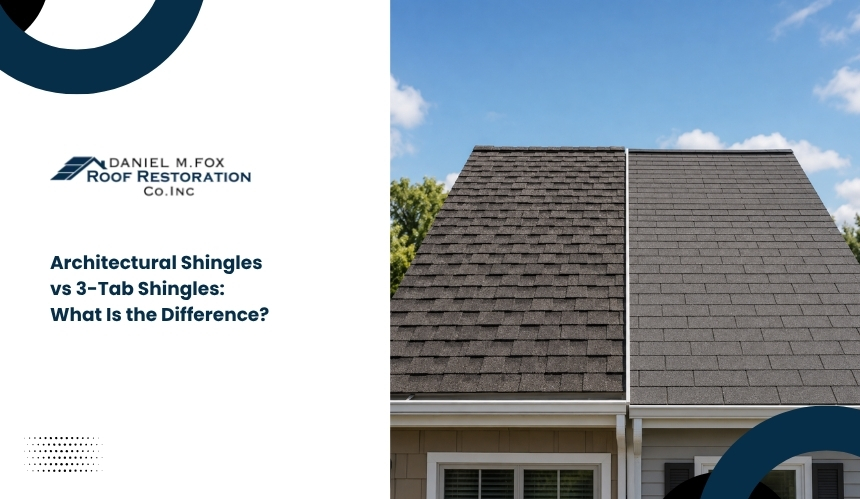
Architectural Shingles vs 3-Tab Shingles: What Is the Difference?
Key Takeaways
|
Choosing between architectural shingles and 3-tab shingles affects far more than the appearance of a roof. The two options differ in construction, weather resistance, lifespan, installation cost, and long-term value, making the wrong choice more expensive over time.
Understanding these differences helps homeowners compare performance instead of focusing only on the initial price. This guide explains how each shingle type performs, where each option fits best, and what factors should guide your decision.
Quick Answer: How Are Architectural Shingles Different From 3-Tab Shingles?
Architectural shingles and 3-tab shingles are both asphalt roofing products, but they are built differently and deliver different levels of performance. Architectural shingles use multiple bonded layers of asphalt to create a thicker, dimensional profile, while 3-tab shingles consist of a single layer with evenly spaced cutouts that produce a flat, uniform appearance.
These structural differences influence several practical outcomes:
- Durability: Architectural shingles are generally more resistant to wind, impact, and everyday wear because of their heavier laminated construction.
- Service Life: Most architectural shingles are designed to last longer than 3-tab shingles when installed correctly and maintained under similar conditions.
- Appearance: The layered design creates shadow lines and texture that resemble premium roofing materials such as cedar shake or slate, whereas 3-tab shingles provide a consistent, traditional look.
- Cost: 3-tab shingles usually have a lower upfront material cost, while architectural shingles often provide greater long-term value through extended lifespan and reduced replacement frequency.
For homeowners deciding between the two, the choice typically comes down to balancing initial budget with long-term performance. A roof expected to withstand harsher weather, remain in place for decades, or enhance curb appeal often benefits from architectural shingles, while 3-tab shingles remain a practical option for projects where minimizing upfront costs is the primary objective
1. Construction and Appearance Differences
The most significant difference between architectural and 3-tab shingles begins with how they are manufactured. Their construction determines not only how the roof looks but also how it responds to wind, rain, temperature changes, and years of exposure to the elements.
Architectural Shingles Use a Laminated, Dimensional Design
Architectural shingles are manufactured by bonding multiple layers of asphalt together, creating a thicker and more rigid roofing material. Rather than using identical tabs across every shingle, manufacturers vary the shape and placement of the laminated layers to produce a dimensional appearance.
This design creates natural shadow lines that mimic higher-end roofing materials such as wood shake or slate without requiring the maintenance those materials typically demand. The additional thickness also increases the shingle’s overall mass, making it less susceptible to deformation caused by heat, wind uplift, or prolonged weather exposure.
3-Tab Shingles Have a Flat, Uniform Profile
A 3-tab shingle is made from a single asphalt layer with three evenly spaced tabs cut into each strip. When installed, these tabs align to create a consistent, repeating pattern across the roof surface.
Because every shingle follows the same shape and thickness, the finished roof has a clean, uniform appearance rather than the textured look produced by laminated products. The lighter construction also makes 3-tab shingles easier to handle during installation, although the reduced material thickness provides less structural mass than architectural shingles.
Why Shingle Construction Affects Performance
The way a shingle is built directly influences how it distributes stress across the roof system. A laminated shingle contains more asphalt, reinforcing material, and mineral granules, allowing it to better absorb repeated expansion and contraction caused by seasonal temperature changes.
This becomes especially relevant in Massachusetts, where roofing systems are exposed to freezing winters, summer heat, heavy rain, and occasional strong wind events throughout the year. In communities such as Winchester, MA, homeowners often prioritize roofing materials that can better withstand repeated freeze-thaw cycles and fluctuating seasonal conditions without compromising long-term performance.
While roof decking, underlayment, ventilation, and installation quality all contribute to overall roof performance, the physical design of the shingle itself establishes the foundation for how the roofing system will perform throughout its service life.
2. Performance Comparison
Construction explains why the shingles differ, but performance determines how those differences affect a roof over time. Factors such as lifespan, resistance to severe weather, and maintenance requirements influence both the total cost of ownership and the level of protection a roofing system can provide.
Lifespan and Long-Term Durability
Under typical residential conditions, 3-tab shingles generally provide about 15 to 20 years of service, while architectural shingles commonly last 25 to 30 years. Higher-grade architectural products may remain functional for 40 years or longer, but that extended lifespan depends on the product line, installation quality, roof ventilation, maintenance, and local exposure conditions. Industry sources also place standard 3-tab roofing near the 20-year mark, while some premium architectural shingles are marketed with substantially longer expected service lives.
Architectural shingles generally last longer because their laminated construction contains more asphalt and reinforcing material. The added thickness slows deterioration caused by ultraviolet exposure, moisture cycling, foot traffic, and thermal movement. In contrast, the lighter single-layer structure of 3-tab shingles tends to show granule loss, curling edges, brittle tabs, and seal failure earlier in the roof’s lifecycle.
For homes in Massachusetts, where roofs endure cold winters, humid summers, and seasonal freeze-thaw cycles, durability often becomes a deciding factor. A roofing system that maintains its structural integrity through changing weather conditions is less likely to require premature replacement.
Which Shingle Handles Wind and Severe Weather Better?
Architectural shingles generally provide stronger resistance to high winds because their greater weight and laminated profile create a more stable roofing surface. Many products are engineered with enhanced sealant strips that improve adhesion between shingles, reducing the likelihood of wind uplift during storms.
A 3-tab roofing system can still perform well when installed correctly, but its lighter construction offers less resistance to strong wind forces. Individual tabs are more exposed, making them more susceptible to lifting or tearing if wind speeds exceed the product’s design limits.
This difference is particularly relevant for homeowners in Winchester, MA, where coastal weather systems and seasonal storms can expose roofs to heavy rain and powerful wind gusts. Selecting shingles with higher wind ratings can contribute to greater long-term roof resilience in these conditions.
Maintenance and Repair Considerations
No roofing material is maintenance-free, but the frequency and type of maintenance often differ between these two shingle categories.
Architectural shingles tend to require fewer repairs related to normal weathering because the thicker laminated construction better resists cracking, lifting, and localized deterioration. Routine inspections remain important, particularly after severe storms, but isolated damage is generally less common on a well-installed architectural roof.
With 3-tab shingles, maintenance may become more frequent as the roof ages. Replacing damaged tabs is often straightforward, yet recurring repairs can accumulate over time if weather exposure accelerates deterioration.
Regardless of shingle type, long-term performance depends on the roofing system as a whole. Proper flashing, effective attic ventilation, quality underlayment, and professional installation all work together with the shingles to maximize durability and reduce the risk of moisture intrusion or premature roof failure.
3. Cost Differences and Long-Term Value
Material price is only one part of the financial decision. A complete comparison should consider installation costs, expected replacement intervals, maintenance expenses, and the value a roof adds throughout its service life rather than focusing solely on the initial purchase price.
Upfront Material and Installation Costs
3-tab shingles remain the lower-cost option in the current U.S. roofing market, making them a practical choice for homeowners with a limited budget or shorter ownership plans.
Typical 3-tab shingle costs:
- Material only: Approximately $80 to $130 per roofing square (100 sq. ft.), or $0.80 to $1.30 per square foot
- Installed cost: Approximately $3.20 to $7.75 per square foot, including labor and standard roofing components
- Average installed cost: Around $4.65 per square foot
Architectural shingles cost more because of their thicker laminated construction and greater material content, but they also offer improved durability and a longer expected service life.
Typical architectural shingle costs:
- Material only: Approximately $100 to $250 per roofing square, or $1.00 to $2.50 per square foot
- Installed cost: Approximately $4.00 to $8.50 per square foot
- Estimated cost for a 2,000 sq. ft. roof: Roughly $8,000 to $17,000, depending on product selection and project complexity
For homeowners in Winchester, MA, the final roofing estimate depends on more than the shingle itself. Roof pitch, multiple valleys, chimney flashing, decking repairs, permit requirements, ice and water shield installation, and local labor rates all influence the total project cost. Comparing detailed estimates that separate materials, labor, tear-off, flashing, ventilation, and repairs provides a more accurate picture than evaluating a single lump-sum price alone.
Replacement Frequency and Lifecycle Cost
A roof with a lower initial price is not always the least expensive over its lifetime. Because architectural shingles generally remain in service longer, they often reduce the likelihood of an earlier full roof replacement.
When replacement materials, labor, disposal fees, and inflation are considered, installing two lower-cost roofs over several decades may exceed the lifetime cost of a single higher-performing architectural roof. Homeowners planning to stay in their property for many years often evaluate lifecycle cost rather than installation cost alone.
That said, a 3-tab roof can still provide good value when the home is expected to be sold in the near future or when budget limitations outweigh the benefit of a longer service life.
Effect on Curb Appeal and Resale Perception
Roofing contributes significantly to a home’s exterior appearance because it occupies a large portion of the visible structure. Architectural shingles create a textured, multi-dimensional surface that complements a wider range of architectural styles and gives the roof greater visual depth.
By comparison, 3-tab shingles produce a clean and uniform appearance that suits many traditional homes but offers less visual variation.
While a new roof does not guarantee a specific increase in resale value, buyers often consider both its condition and expected remaining lifespan during the purchasing process. A well-installed architectural shingle roof can strengthen first impressions and reduce concerns about near-term replacement costs, making it a practical investment for homeowners seeking both durability and long-term market appeal.
Which Type of Shingle Is Better for Your Home?
There is no universal “best” roofing shingle because the right choice depends on your budget, expected length of home ownership, local climate, and long-term priorities. Comparing these factors against the strengths of each shingle type leads to a more informed decision than choosing based on price alone.
Choose Architectural Shingles When Durability and Appearance Matter Most
Architectural shingles are typically the better investment when long-term performance is the primary goal. Their thicker laminated construction provides greater resistance to weather-related wear while creating a dimensional roof that enhances curb appeal.
Architectural shingles are often the preferred option when you:
- Plan to stay in your home for many years
- Want a roof with a typical lifespan of 25 to 30 years or more
- Live in an area exposed to strong winds, heavy snow, or frequent seasonal weather changes
- Want a roof that resembles cedar shake or slate without the maintenance requirements
- Value long-term durability over the lowest initial installation cost
For many homeowners in Massachusetts, architectural shingles provide an added level of confidence because they are better suited to handle the combination of snow loads, freeze-thaw cycles, heavy rain, and summer heat that roofing systems experience throughout the year.
Choose 3-Tab Shingles When Upfront Affordability Is the Priority
3-tab shingles remain a practical roofing solution when keeping installation costs as low as possible is the primary objective. Although they generally have a shorter service life, they can still provide dependable protection when installed correctly and maintained properly.
A 3-tab roof may be the better choice if you:
- Need to minimize the upfront roofing budget
- Plan to sell the property within the next several years
- Own a rental property where cost efficiency is a priority
- Have a simple roof design with minimal exposure to severe weather
- Prefer a clean, uniform roof appearance
Selecting a lower-cost roof does not necessarily mean sacrificing quality, but it does mean understanding that replacement may be required sooner than with a laminated architectural roofing system.
Consider Climate, Roof Condition, and Warranty Requirements
The best-performing shingle can only perform as well as the roof system supporting it. Before selecting either option, homeowners should evaluate the condition of the roof deck, attic ventilation, flashing, and drainage because these components directly affect roof longevity.
Climate should also influence the decision. Homes in regions such as Winchester, MA, where roofs are exposed to winter snow, ice dams, spring rain, and seasonal wind events, often benefit from roofing systems designed for higher weather resistance. For homeowners planning asphalt shingles roofing in Winchester, MA, selecting shingles with stronger wind ratings and ensuring proper installation can provide greater long-term reliability than focusing solely on the initial purchase price.
Finally, compare manufacturer warranties carefully. Warranty length alone should not determine the decision, as coverage typically includes specific installation requirements, ventilation standards, and maintenance conditions. Understanding both the warranty terms and the expected real-world lifespan provides a more accurate basis for choosing the right roofing material.
Whether you’re replacing an aging roof or comparing roofing materials for a new project, expert guidance can help you make a confident decision. Daniel Fox Roofing provides professional asphalt shingle roofing solutions for homeowners throughout Greater Boston and the surrounding Massachusetts communities, helping you select and install the roofing system that best fits your home, budget, and long-term goals. Contact our team today to schedule your roofing consultation.
Frequently Asked Questions
Can architectural shingles be installed over an existing 3-tab roof?
An overlay may be possible when the existing roof has one sound shingle layer, the deck remains structurally suitable, and local building requirements permit roof recovering. A complete tear-off is preferable when shingles are curled, uneven, leaking, or concealing deck damage because it allows direct sheathing inspection and proper underlayment installation.
Can architectural shingles be used to patch a damaged 3-tab roof?
Architectural shingles are not a direct replacement for individual 3-tab shingles. Their thickness, exposure pattern, seal placement, and tab geometry differ, which can produce uneven courses and unreliable water shedding. A permanent repair should use a compatible shingle with the correct dimensions, fastening pattern, and manufacturer-approved installation method.
Are architectural shingles too heavy for an older home?
Most structurally sound homes can support architectural asphalt shingles, but older framing, weakened decking, and previous roof overlays require evaluation. The concern is not limited to shingle weight. Snow accumulation, moisture-damaged sheathing, sagging rafters, and multiple roofing layers can increase structural loading, making a pre-installation roof inspection necessary.
Can architectural shingles lower homeowners insurance premiums?
Insurance savings depend on the product’s tested impact or wind rating, not simply its architectural classification. Some insurers offer discounts for qualifying Class 4 impact-resistant shingles or documented wind-mitigation upgrades, while others provide no credit. Homeowners should confirm eligible products and required installation certificates with their insurer before selecting an upgrade.
Why is it difficult to match older shingles during a roof repair?
Existing shingles gradually experience granule loss, fading, and weather-related color changes. New shingles with the same marketed color may still appear different because of manufacturing dates, plant variations, or product-line changes. Recording the brand, style, color code, and installation date can make future shingle identification and matching more accurate.