
- danielfox
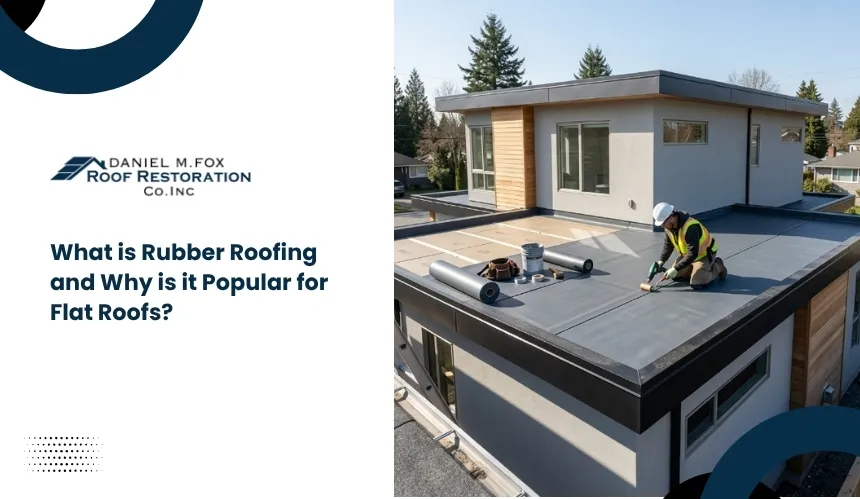
What is Rubber Roofing and Why is it Popular for Flat Roofs?
Key Takeaways:
|
Flat roofs often face recurring issues like water pooling, membrane cracks, and premature material failure due to constant exposure and minimal drainage slope. Choosing the wrong roofing system can lead to frequent leaks, higher maintenance costs, and reduced structural lifespan.
Rubber roofing has emerged as a preferred solution because it addresses these exact performance gaps through flexibility, waterproofing efficiency, and durability. This article explains what rubber roofing is and why it is widely used for flat roof applications.
Why Flat Roofs Require Specialized Roofing Materials
Flat roofs operate under continuous exposure and minimal drainage, which changes how materials perform over time. Unlike sloped systems, they do not allow efficient water runoff, so moisture often remains on the surface for extended periods. This increases pressure on joints and weak areas, making leak resistance a critical requirement.
These surfaces also absorb direct sunlight throughout the day, leading to sustained heat buildup and repeated expansion cycles. Materials that cannot handle thermal movement or UV exposure begin to deteriorate, resulting in surface damage and reduced lifespan.
In addition, flat roofs often carry equipment loads, foot traffic, and debris accumulation. Heavier or rigid systems add structural strain, which is why lightweight, flexible materials are generally more effective for maintaining long-term performance.
What Is Rubber Roofing and How Does It Work on Flat Roofs?
Rubber roofing is designed to create a continuous, waterproof barrier that performs reliably on low-slope structures where traditional materials fail. Its effectiveness comes from membrane-based installation, which minimizes joints and adapts to structural movement.
What Materials Are Used in Rubber Roofing Systems?
Most rubber roofing systems are built using EPDM (ethylene propylene diene monomer), a synthetic rubber membrane engineered for outdoor durability. This material resists UV radiation, ozone exposure, and chemical degradation, which are common failure triggers in flat roof environments.
EPDM is typically manufactured in large sheets, reducing the number of seams across the surface. Fewer seams directly lower the probability of water infiltration. In some cases, liquid-applied rubber coatings are used to form a seamless layer over complex roof geometries, ensuring full surface coverage without mechanical joints.
How Rubber Roofing Performs on Flat and Low-Slope Surfaces
Flat roof systems require materials that can maintain continuous surface coverage under low-drainage conditions. Rubber roofing achieves this through a non-porous membrane that acts as a surface barrier, preventing water from passing through the material layer.
The membrane structure allows for controlled expansion and contraction in response to temperature variation, maintaining surface continuity without separation.
Installation methods such as fully adhered bonding, mechanical fastening, or ballasted placement determine how the membrane is secured to the substrate and how it responds to external forces like wind uplift and structural movement.
Key Advantages of Rubber Roofing for Flat Roof Applications
Rubber roofing gains preference because it directly addresses the performance limitations of flat roof environments. Its material composition and installation approach are engineered to reduce failure points while maintaining long-term stability under continuous exposure.
1. Superior Waterproofing and Leak Resistance
Rubber membranes are installed in large sheets or as continuous coatings, which significantly reduces the number of joints across the surface. Fewer seams translate into fewer entry points for water intrusion. In fully adhered systems, the membrane forms a tight bond with the substrate, preventing water migration even under prolonged surface exposure.
2. Flexibility and Durability in Extreme Conditions
The material retains elasticity across a wide temperature range, allowing it to accommodate structural movement without developing cracks. This flexibility prevents stress-related damage caused by expansion and contraction cycles, which are common on flat roofs exposed to daily temperature variation.
3. Low Maintenance and Long Lifespan
Rubber roofing systems require minimal ongoing intervention because the membrane resists tearing, puncturing, and environmental degradation. Routine inspections and basic cleaning are typically sufficient to maintain performance, and properly installed systems can operate effectively for multiple decades without major repairs.
4. Energy Efficiency and Thermal Performance
Rubber membranes, especially in lighter or reflective variants, reduce heat absorption at the surface level. Lower surface temperatures decrease heat transfer into the building, improving indoor thermal stability and reducing reliance on mechanical cooling systems.
How Rubber Roofing Compares to Other Flat Roof Materials
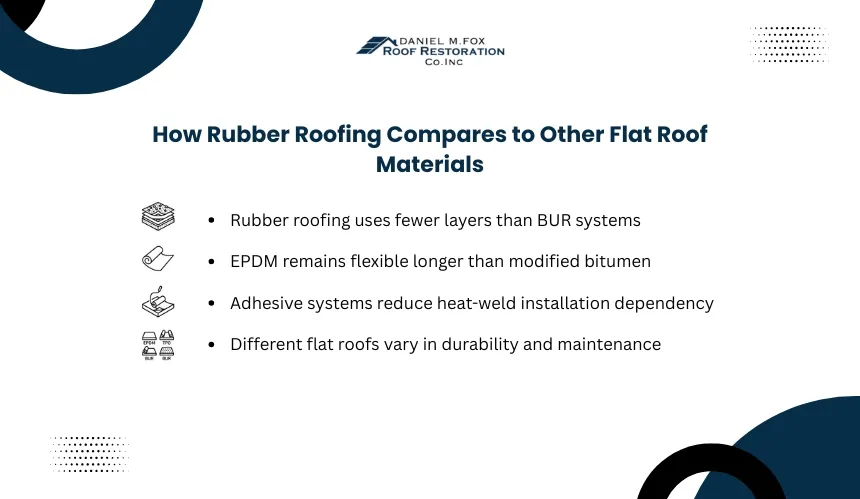
Material selection often depends on how different systems perform under similar conditions. Comparing rubber roofing with other flat roof options helps clarify trade-offs in installation complexity, material behavior, and long-term reliability.
Rubber Roofing vs Built-Up Roofing (BUR)
Built-up roofing systems consist of multiple layers of bitumen and reinforcing fabrics applied in sequence. This layered approach increases thickness but also introduces multiple bonding interfaces where failure can occur.
In contrast, rubber roofing uses a single membrane layer, which reduces assembly complexity and limits the number of potential separation points during installation.
Rubber Roofing vs Modified Bitumen
Modified bitumen systems combine asphalt with polymer modifiers to improve flexibility, but they still rely on layered application and heat-based installation methods. These systems can become rigid over time as the material ages.
Rubber membranes maintain consistent elasticity because their structure is not dependent on layered bonding or thermal welding during installation.
Rubber Roofing vs TPO and PVC Systems
Thermoplastic systems like TPO and PVC rely on heat-welded seams to create a continuous surface. While this creates strong seam bonds, the overall system performance depends heavily on installation precision.
Rubber roofing membranes, particularly EPDM, use adhesive-based or mechanical attachment methods, which change how the system responds to substrate movement and environmental stress without relying on heat fusion.
Choosing the right flat roofing system impacts long-term performance, maintenance costs, and structural protection. If you’re evaluating rubber roofing for your property, Daniel Fox Roofing provides expert guidance and precision installation tailored to your roof’s requirements. Get reliable recommendations and a solution built for lasting performance.
Frequently Asked Questions
How long does rubber roofing usually last on a flat roof?
A properly installed EPDM rubber roof commonly lasts 25 to 40 years, depending on membrane thickness, drainage quality, UV exposure, and maintenance frequency. Roofs with routine inspections, clean drainage points, and prompt seam repairs generally perform longer than systems exposed to standing water, trapped debris, or repeated foot traffic.
Can rubber roofing be installed over an existing flat roof?
Rubber roofing can be installed over an existing flat roof when the substrate is dry, stable, clean, and structurally sound. Trapped moisture, soft insulation, loose materials, or uneven surfaces must be corrected first because they can weaken adhesion, create membrane movement, and cause hidden damage beneath the new roof layer.
Is black rubber roofing a problem in hot weather?
Black EPDM absorbs more heat than lighter roofing membranes, which can raise surface temperatures during hot months. However, proper insulation, ventilation, and reflective coatings can reduce heat transfer into the building. In colder climates, black rubber may also support winter heat retention, making climate a key selection factor.
What maintenance does a rubber flat roof need?
Rubber flat roofs need periodic inspections, debris removal, drainage checks, and seam monitoring. Leaves, branches, and clogged drains can hold moisture against the membrane, increasing stress around roof edges and penetrations. Small punctures or lifted seams should be repaired early, before water reaches the insulation or the roof deck.
Can people walk on a rubber roof without damaging it?
Limited foot traffic is usually acceptable, especially for inspections or servicing rooftop equipment. Repeated walking, sharp tools, heavy equipment, or dragging materials can puncture or abrade the membrane. Walk pads are recommended around HVAC units, access points, and maintenance routes to protect the roof surface from concentrated wear.
Is rubber roofing better for residential or commercial flat roofs?
Rubber roofing works for both residential and commercial flat roofs, but its suitability depends on roof size, access needs, drainage design, and budget. It is commonly used on home additions, garages, dormers, retail buildings, warehouses, and low-slope structures where flexible membrane coverage is more practical than layered roofing systems.