
- danielfox
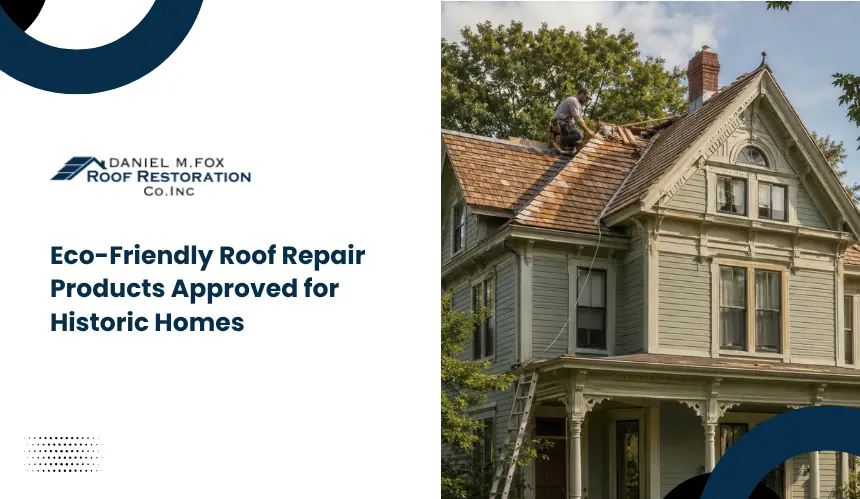
Eco-Friendly Roof Repair Products Approved for Historic Homes
Key Takeaways:
|
Historic homes require roof repairs that preserve original materials, structural integrity, and regulatory compliance. Standard roofing products often introduce chemical incompatibility, moisture imbalance, or visual alterations that violate preservation standards. This creates a narrow margin where both sustainability and historical accuracy must align.
Eco-friendly roof repair products offer a viable path, but only when they meet both environmental and conservation requirements. The challenge lies in identifying materials that perform without compromising the building’s original fabric.
This article explains how to evaluate, select, and apply eco-friendly roofing solutions that are approved for historic properties.
Why Standard Roofing Products Often Fail in Historic Home Repairs
Standard roofing products are designed for modern systems, not traditional structures. When used on historic roofs, they disrupt moisture balance, reduce breathability, and accelerate material breakdown.
Key failure points include:
- Non-breathable sealants trap moisture, leading to wood rot, metal corrosion, and slate delamination
- Material mismatch causes poor adhesion, cracking, and uneven structural stress
- High-VOC chemicals react with older substrates, weakening integrity and altering appearance
- Preservation regulations restrict materials that change original design or composition
These issues reduce lifespan and increase repair frequency. Effective solutions must work with the original material behavior, not against it.
What Makes a Roof Repair Product Eco-Friendly and Preservation-Compliant
Eco-friendly historic roof products must meet both environmental and structural compatibility standards. Performance within traditional systems is as critical as sustainability.
Core qualification factors include:
- Low-toxicity composition using mineral, plant-based, or water-based materials
- Compatibility with historic substrates to handle expansion, moisture absorption, and aging behavior
- Breathability to allow vapor movement and prevent internal moisture buildup
- Sustainable sourcing such as recycled or renewable materials with long-term durability
- Verified compliance with local preservation guidelines and material approval standards
A product is only suitable when it balances environmental safety, structural performance, and regulatory acceptance.
Types of Eco-Friendly Roof Repair Products Used in Historic Homes
Historic roof repairs rely on materials that preserve original performance while reducing environmental impact. The following product categories are commonly used where both sustainability and preservation standards must be met.
1. Natural Sealants and Lime-Based Mortars
Used in masonry joints, flashing interfaces, and traditional roofing systems, these materials maintain flexibility and vapor permeability. Lime-based mortars adapt to thermal movement and allow moisture to escape, preventing internal stress buildup and surface cracking.
2. Reclaimed and Recycled Roofing Materials
Salvaged slate, clay tiles, and wood shakes retain the original visual and structural characteristics of historic roofs. Reusing these materials reduces resource extraction while ensuring compatibility with existing roof sections, especially in partial repairs.
3. Plant-Based or Low-Toxicity Coatings
Applied to wood and metal roofs, these coatings provide protection against UV exposure, moisture penetration, and biological growth. Their formulations avoid harsh solvents, reducing chemical impact while maintaining surface durability and finish consistency.
4. Eco-Friendly Underlayments and Membranes
These layers act as secondary protection beneath the roof surface. Breathable membranes made from recycled or natural fibers prevent water ingress while allowing trapped moisture to escape, supporting long-term structural stability without sealing the system completely.
5. Synthetic Composite Alternatives
Some historic repair projects use synthetic composite roofing products as selective replacements when original materials are no longer available or cannot be sourced consistently.
These alternatives must be evaluated carefully for visual match, thermal movement, moisture behavior, and preservation approval before use on a historic home.
If you want, I can also tighten this section slightly so it matches the length and tone of the rest of the article even more closely.
How to Choose the Right Product for Your Historic Roof Type
Product selection depends on how well the material aligns with the roof’s structure, exposure conditions, and regulatory limits. A correct choice maintains system balance while preventing premature failure.
Validating Compatibility Between Product and Existing Roof System
Compatibility is not defined by material type alone but by how the product behaves under real conditions. Selection should focus on performance alignment rather than category matching.
- Check thermal movement behavior to ensure the product expands and contracts at a similar rate as the existing roof
- Evaluate moisture interaction to confirm the product does not trap or redirect water within the system
- Assess bonding mechanism to avoid rigid adhesion on surfaces that require flexibility
- Review aging characteristics to ensure the repair material weathers at a similar rate as surrounding elements
A product fails not because it is incorrect in category, but because it disrupts the functional balance of the existing roof system.
Evaluating Climate and Environmental Exposure
Environmental conditions directly influence product performance.
- High humidity zones require vapor-permeable materials to prevent internal condensation
- Freeze-thaw regions demand flexible compounds that resist expansion stress
- High UV exposure requires coatings with stable, non-degrading formulations
In the Greater Boston area, including communities like Newton and Dedham, repeated freeze-thaw cycles combined with coastal moisture create constant expansion pressure on historic roofing systems.
Older homes across surrounding areas such as Cambridge and Brookline often require breathable, flexible repair materials to handle seasonal saturation and winter contraction without surface cracking or internal moisture buildup.
Compliance with Local Preservation Regulations
Historic districts often enforce strict material and method approvals. Selection must include:
- Verified product documentation
- Visual consistency with original roofing
- Approval from local historic commissions or conservation authorities
Non-compliance can result in rejected work or mandated removal after installation.
Balancing Sustainability with Durability
Short-term eco benefits do not justify reduced lifespan. Product evaluation should consider:
- Lifecycle performance versus replacement frequency
- Maintenance requirements over time
- Structural impact on surrounding materials
A suitable product delivers environmental benefits without increasing long-term repair cycles.
Common Mistakes to Avoid When Using Eco-Friendly Products on Historic Roofs
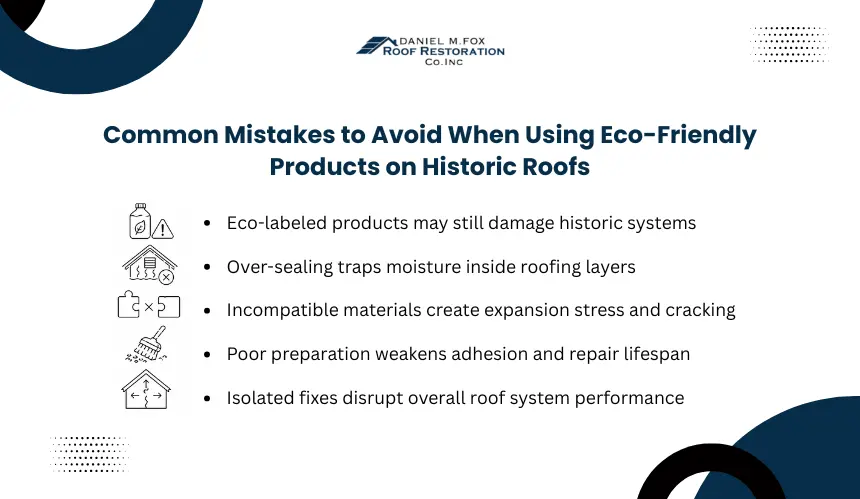
Even when sustainable materials are selected, incorrect application or misjudgment can compromise the entire roof system. Most failures occur due to misuse rather than product quality.
1. Using “Eco-Labeled” Products Without Historic Compatibility
Many products marketed as eco-friendly are designed for modern roofing systems. Without verifying compatibility with traditional materials, these products can disrupt moisture flow, weaken bonding, and create long-term structural imbalance.
2. Over-Sealing and Blocking Natural Ventilation
Historic roofs rely on controlled airflow and vapor movement. Applying sealants or coatings that fully block permeability traps moisture inside the system, increasing the risk of wood rot, internal condensation, and hidden decay.
3. Mixing Incompatible Materials Within the Same System
Combining modern synthetic products with traditional materials creates uneven expansion and contraction behavior. This mismatch leads to stress points, surface cracking, and premature joint failure across connected roof sections.
4. Ignoring Proper Substrate Preparation
Eco-friendly products still require a stable and clean surface to perform correctly. Skipping preparation steps such as removing debris, stabilizing damaged areas, or correcting moisture presence reduces adhesion strength and shortens the repair lifespan.
5. Treating Repairs as Isolated Fixes Instead of System-Level Adjustments
Historic roofing systems function as interconnected layers. Applying a product without considering its effect on adjacent materials can disrupt load distribution, moisture pathways, and overall system balance, leading to cascading failures over time.
Choosing the right materials for a historic roof is not just about repair, it is about protecting long-term value and architectural integrity. Daniel Fox Roofing specializes in restoration-focused solutions that align with preservation standards and modern performance expectations. Connect with their team to ensure your roof is repaired with the precision and care historic properties demand.
Frequently Asked Questions
How can homeowners tell if an older roof repair is causing hidden compatibility problems?
Warning signs usually show up as isolated cracking, trapped moisture, unusual staining, fastener corrosion, or repeated failure in the same area. On historic roofs, these patterns often point to a past repair that changed breathability, thermal movement, or bonding behavior. A preservation-minded inspection should evaluate the full roof system, not just the damaged spot.
Is partial roof repair usually better than full replacement for a historic home?
Partial repair is often the smarter option when most original roofing materials remain serviceable. It preserves more of the building fabric, reduces waste, and improves approval odds with historic commissions. The key is matching aging characteristics, moisture behavior, profile, and structural load so the repaired section does not fail faster than adjacent areas.
What paperwork should be reviewed before choosing a roof repair product for a historic property?
Homeowners should review local historic district guidelines, prior repair records, product data sheets, VOC and composition details, and any manufacturer documentation on vapor permeability and substrate compatibility. For regulated properties, visual samples and application methods may also matter. Approval risk drops when technical documentation and preservation criteria are checked before material purchase.
Can an eco-friendly underlayment improve performance even if the visible roof material stays the same?
In many cases, yes. A breathable underlayment or membrane can improve moisture control beneath slate, clay tile, or wood roofing without changing the visible exterior. That matters on historic homes where appearance must remain intact. The upgrade only works, however, when airflow, drainage paths, and surrounding materials remain compatible.
How should homeowners weigh higher upfront cost against long-term sustainability?
The better comparison is lifecycle value, not purchase price alone. A product that lasts longer, requires fewer interventions, and avoids damaging adjacent historic materials usually delivers better environmental and financial results. On older roofs, a cheaper product can become the more expensive option if it triggers repeat repairs, removal, or preservation compliance issues.
How often should a repaired historic roof be inspected in Massachusetts conditions?
In Greater Boston area conditions, especially around Newton, Dedham, Cambridge, and nearby communities, annual inspection is a practical baseline, with an additional check after severe winter weather. Freeze-thaw cycling, coastal moisture, and seasonal saturation can stress joints, flashing, and repair compounds faster than homeowners expect, particularly on older roofing assemblies.
Can energy-efficiency upgrades be added without compromising a historic roof repair plan?
They can, but only when the upgrade does not alter moisture balance, roof profile, or approved appearance. Even well-intended efficiency additions can interfere with ventilation, drainage, or preservation compliance. On historic homes, the safest approach is to evaluate insulation, membranes, coatings, and any add-on system as part of one coordinated roofing strategy.