
- danielfox
The Science of Roof Patina: How Age Adds Value to Historic Metals
Key Takeaways:
|
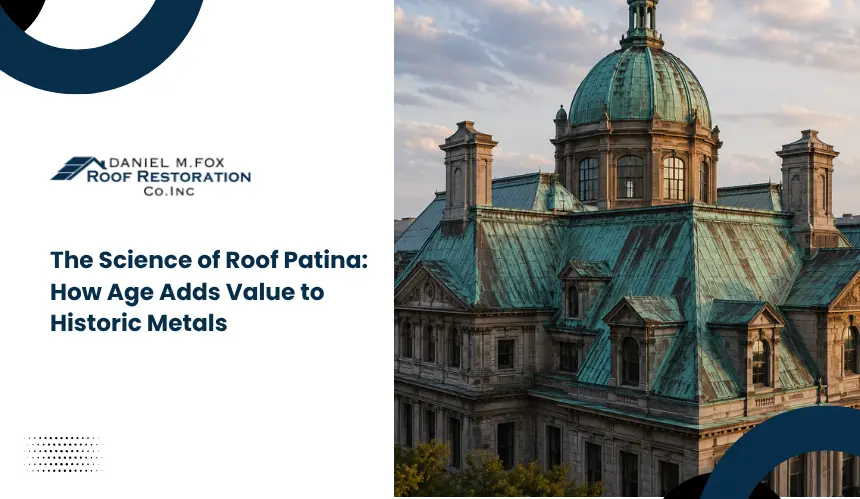
Aging metal roofs on historic buildings are often misinterpreted as deteriorating assets, leading to premature restoration or replacement decisions that reduce both material lifespan and architectural value. The visible surface change, commonly seen as discoloration or weathering, is not always damage. In many cases, it is a chemically stable layer that protects the underlying metal and enhances long-term performance.
This article explains the science behind roof patina, how it forms, and why it plays a critical role in both preservation and property value.
What Is Roof Patina and Why Does It Matter in Historic Metal Roofing
Patina is a chemically evolved surface layer that forms on exposed metals over time, altering both appearance and performance characteristics. In historic roofing systems, this transformation is not cosmetic aging but a material response that directly influences durability, maintenance strategy, and asset valuation.
Chemical Definition of Patina in Metal Roofing Systems
Patina is the result of controlled chemical reactions between a metal surface and environmental agents such as oxygen, moisture, carbon dioxide, and airborne particulates. These reactions produce stable compounds, such as copper carbonate on copper or zinc carbonate on zinc, which adhere to the surface as a thin, cohesive film.
Unlike loose oxidation products, this layer integrates with the base metal at a molecular level, creating a self-limiting reaction. Once formed, the patina slows further chemical activity, stabilizing the material against aggressive environmental exposure.
Difference Between Patina and Corrosion or Structural Damage
Patina represents a passivation process, while corrosion reflects uncontrolled material degradation. The distinction is operational rather than visual. A stable patina maintains surface continuity and protects the substrate, whereas corrosion introduces material loss, pitting, and structural compromise.
In roofing assessments, uniform coloration and consistent surface texture typically indicate protective patina development. In contrast, irregular scaling, flaking, or localized penetration signals active corrosion requiring intervention. Misclassification at this stage often leads to unnecessary replacement or overlooked risk.
Why Historic Buildings Preserve Patina Instead of Replacing Materials
Preservation frameworks prioritize original material retention because patina confirms long-term environmental compatibility. A metal roof that has developed a stable patina has effectively calibrated itself to its exposure conditions, reducing future degradation risk.
From a regulatory and valuation perspective, removing patina disrupts historical authenticity and can diminish compliance with conservation standards. More importantly, replacement eliminates a naturally formed protective barrier, forcing new materials to restart the exposure cycle without proven performance in that environment.
How Patina Forms: The Chemical and Environmental Processes Behind It
Patina formation is driven by predictable chemical reactions between exposed metal surfaces and environmental inputs. The rate, composition, and stability of this layer depend on metal type, atmospheric chemistry, and long-term exposure conditions.
Oxidation and Atmospheric Reactions Driving Surface Transformation
Patina formation is not a single reaction but a staged progression that evolves over time. The process starts with rapid surface oxidation, creating an initial layer that remains chemically active and permeable. At this stage, the metal is still exposed to continuous environmental interaction.
As exposure continues, these early compounds undergo secondary transformations, reorganizing into more stable and less reactive structures. This transition reduces surface reactivity and gradually limits further chemical exchange with the environment.
The critical shift occurs when the surface layer reaches a point where it restricts moisture and oxygen penetration. At this stage, the reaction rate drops significantly, and the metal enters a passive condition. This progression, rather than the presence of oxidation itself, determines whether the outcome is protective patina or ongoing degradation.
Metal-Specific Reactions: Copper, Zinc, Lead, and Steel
Each metal develops a distinct patina based on its chemical behavior. Copper forms copper carbonate, which produces the characteristic green surface commonly associated with historic structures. Zinc develops zinc carbonate, creating a matte gray layer that stabilizes quickly under consistent exposure.
Lead forms lead oxide and lead carbonate, resulting in a muted, uniform finish with high resistance to further environmental interaction. Steel behaves differently, as it tends to form iron oxide, which is typically unstable unless alloyed or treated. In untreated steel systems, this process leads to progressive corrosion rather than protective patina formation.
Role of Climate Factors in Patina Development
Environmental conditions directly influence how efficiently patina forms and stabilizes, and this is especially evident across Massachusetts microclimates. In areas like Cambridge and Brookline, dense urban exposure introduces higher levels of sulfur dioxide and particulate matter, accelerating surface reactions and often producing a darker, faster-developing patina layer. This urban chemistry can enhance early-stage formation but may also create uneven composition if pollutants are concentrated.
In contrast, suburban zones such as Newton and Weston experience more balanced atmospheric conditions with moderate humidity and lower pollutant density. These environments typically support slower, more uniform patina development, resulting in a stable and evenly distributed protective layer over time.
Temperature variability across regions like Concord and Arlington introduces repeated freeze-thaw cycles. These cycles drive expansion and contraction in metal surfaces, influencing how consistently the patina bonds and evolves. When reactions occur uniformly, this strengthens layer adhesion. When inconsistent, it can create localized stress points that require monitoring.
The interaction between humidity, pollutants, and temperature cycles ultimately determines whether the patina stabilizes into a protective barrier or remains in a reactive state. In Massachusetts conditions, this balance is highly location-dependent, making localized assessment critical for accurate evaluation.
Functional Benefits of Patina on Roofs Beyond Appearance
Once fully developed, patina transitions from a chemical byproduct to a performance layer that directly influences how a metal roof behaves under long-term exposure. Its value lies in operational outcomes such as protection, durability, and reduced lifecycle intervention.
1. Protective Barrier Formation Against Environmental Exposure
A mature patina acts as a diffusion-resistant layer that limits the penetration of moisture, oxygen, and corrosive agents to the base metal. This barrier is not applied but formed in place, which allows it to bond tightly with the substrate and eliminate weak adhesion points.
By reducing direct exposure, the patina slows down electrochemical reactions that would otherwise lead to material breakdown. This creates a controlled surface condition where further environmental impact is minimized rather than continuously reacting with the metal.
2. Impact on Longevity and Structural Stability
The presence of a stable patina directly extends the service life of metal roofing systems by reducing the rate of material loss. Since the underlying metal is shielded from aggressive exposure cycles, structural thickness and integrity are preserved over time.
This effect is particularly critical in historic systems where original materials are expected to perform across decades or centuries. Instead of periodic degradation, the roof enters a stabilized phase where performance becomes predictable and less dependent on external intervention.
3. Reduced Maintenance and Lifecycle Cost Implications
Patinated surfaces require fewer corrective actions because the protective layer reduces the frequency of damage-related issues. Cleaning requirements shift from corrective maintenance to surface preservation, and the need for coatings or chemical treatments is significantly reduced.
From a cost perspective, this lowers both routine maintenance expenses and long-term capital replacement risk. Property owners benefit from extended service intervals and fewer disruptive repair cycles, which is a key factor in managing historic or high-value architectural assets.
How Patina Influences Property Value and Architectural Significance
Patina shifts from a material condition to a valuation signal when assessed in the context of historic assets. It affects how a property is perceived, appraised, and regulated, particularly where authenticity and long-term performance are tied to original materials.
Perceived Authenticity in Historic and Heritage Properties
Patina provides visible evidence of age continuity, confirming that the metal has remained in place and adapted to its environment over time. In heritage evaluations, this continuity supports claims of material originality, which is a key criterion in preservation frameworks.
Removing or artificially altering this surface condition disrupts that continuity, often reducing historical credibility. In regulated districts, such interventions can trigger compliance issues or require justification under conservation guidelines.
Buyer Psychology and Market Signaling of Aged Metals
In high-value and historic property segments, patina functions as a signal of durability rather than neglect. Buyers interpret stable aging as proof that the material has performed under real conditions without failure. This reduces perceived risk, especially when compared to newly installed systems with no exposure history.
The visual depth and uniform aging pattern also contribute to perceived craftsmanship and material quality. These factors influence buyer confidence and can impact negotiation outcomes, particularly in markets where architectural character drives demand.
Role in Preservation Standards and Regulatory Compliance
Preservation bodies often require retention of original materials and discourage alterations that remove historically developed surface conditions. Patina aligns with these standards because it represents a naturally evolved state rather than a modified finish.
In many cases, maintaining patina simplifies approval processes for restoration work, as it demonstrates adherence to conservation principles. Conversely, attempts to clean, coat, or replace patinated surfaces can lead to regulatory friction, delays, or additional review requirements.
When Roof Patina Adds Value vs When It Signals a Problem
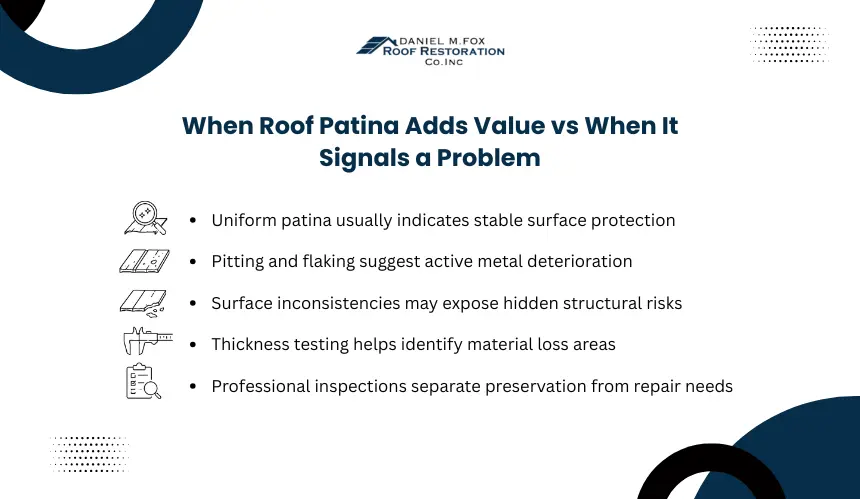
Not all surface aging indicates stability. The distinction between value-adding patina and active deterioration determines whether a roof should be preserved or corrected. Accurate classification at this stage directly impacts risk exposure, repair scope, and long-term asset performance.
Indicators of Stable Patina vs Active Deterioration
A functional patina presents as a continuous, well-adhered surface layer with uniform tone and texture across exposure zones. It remains intact under light mechanical contact and does not expose raw metal beneath. This condition reflects a stabilized reaction state where further environmental interaction is limited.
In contrast, active deterioration disrupts surface continuity. The layer may appear uneven, with localized breakdown where the underlying metal becomes visible or chemically active. These areas indicate that the surface is no longer acting as a protective barrier.
Warning Signs: Pitting, Flaking, and Structural Material Loss
Pitting introduces localized cavities that penetrate beneath the surface layer, often signaling aggressive electrochemical activity. Unlike patina, which remains superficial and protective, pitting reduces material thickness and can compromise load-bearing capacity over time.
Flaking or scaling indicates that the surface layer has lost adhesion to the substrate. This exposes fresh metal to environmental agents, accelerating degradation cycles.
In advanced cases, repeated loss of surface material leads to measurable thinning, increasing the risk of perforation or structural failure.
Inspection and Assessment Protocols for Metal Roofing Systems
Evaluation should move beyond visual inspection and incorporate surface integrity testing and thickness measurement where necessary. Key assessment steps include:
- Verifying adhesion of the surface layer through controlled contact testing
- Identifying inconsistencies in color or texture that indicate localized reaction changes
- Measuring material thickness in high-exposure zones to detect hidden loss
- Reviewing drainage patterns and water retention areas that may accelerate deterioration
A structured assessment allows decision-makers to separate areas that require preservation from those needing targeted intervention, preventing unnecessary replacement while addressing genuine risk.
Managing and Preserving Roof Patina Without Compromising Performance
Effective management focuses on retaining the existing patina while preventing localized conditions that could reactivate surface degradation. The objective is not restoration to a “new” appearance, but stabilization of a proven surface state.
Cleaning and Maintenance Practices That Preserve Patina Layers
Maintenance should be limited to non-invasive methods that remove debris without disturbing the bonded surface layer. Low-pressure rinsing and neutral pH cleaning agents are typically sufficient to clear organic buildup, pollutants, and drainage residues.
Abrasive tools, acidic cleaners, or aggressive washing techniques disrupt the surface equilibrium by stripping sections of the patina. Once removed, these areas re-enter an active reaction phase, creating inconsistency across the roof and increasing long-term risk.
When Restoration Should Respect Existing Patina
Historic roof restoration strategies should prioritize material continuity over visual uniformity. Interventions are justified only where structural performance is compromised, not where surface variation exists. In practice, this means isolating and treating localized defects while leaving stable patinated areas untouched.
Replacing or refinishing large sections to achieve a uniform appearance often removes a fully developed protective layer and introduces new material that has not yet adapted to the environment. This resets the aging cycle and can create uneven performance across the system.
Modern Treatments That Stabilize Without Altering Appearance
Where additional protection is required, treatments should be compatible with the existing patina and designed to reinforce rather than replace it. Microcrystalline waxes, breathable sealants, and corrosion inhibitors can be applied in controlled conditions to enhance moisture resistance without blocking vapor exchange.
These solutions maintain the visual and chemical integrity of the patina while addressing specific exposure risks. Selection should be based on metal type, environmental conditions, and existing surface stability to avoid unintended chemical interactions or long-term performance issues.
Not sure whether your metal roof’s patina is protecting it or putting it at risk? Get a professional evaluation before making costly decisions. The team at Daniel Fox Roofing specializes in assessing historic metal roofs, helping property owners preserve value while addressing real structural concerns.
Frequently Asked Questions
Can a roof lose value if the patina is cleaned off too aggressively?
Yes, especially on historic metal roofing where surface aging is part of the material’s functional and architectural value. Abrasive cleaning, chemical stripping, or polishing can remove the stabilized protective layer, expose fresh metal, and reduce authenticity. In preservation-sensitive properties, there can also be compliance issues and weaken appraisal perception.
How long does it usually take for a protective patina to fully develop on a metal roof?
The timeline depends on metal type, moisture exposure, airborne pollutants, and temperature cycling. Copper and zinc can begin visible transformation within a few years, but a mature, stable patina often takes much longer. In Massachusetts conditions, urban exposure, freeze-thaw cycles, and humidity can accelerate or complicate that progression.
Does uneven patina always mean the roof is failing?
Not necessarily. Uneven coloration can result from drainage patterns, roof pitch, shading, pollution concentration, or patchy moisture retention rather than structural failure. The real concern is whether the surface remains adhered and protective. If uneven appearance is paired with flaking, pitting, or exposed raw metal, the issue shifts from aesthetic variation to active deterioration.
Is it better to repair one damaged section or replace the whole historic metal roof?
For most historic roofing systems, localized repair is the stronger strategy when the majority of the patinaed surface remains stable. Full replacement often removes serviceable original material, resets the weathering cycle, and creates visual and performance inconsistency. The decision should be based on substrate integrity, material thickness, water entry risk, and preservation requirements.
Are modern coatings a good idea on patinated copper or zinc roofs?
Only when the treatment is chemically compatible and necessary for a specific exposure risk. Many coatings interfere with vapor movement, alter appearance, or trap moisture against the metal surface. On copper roofing or zinc roofing with a stable patina, breathable stabilization methods are usually safer than applying a film-forming finish across the entire roof.
What kind of roof inspection is best for determining whether patina is protective or problematic?
A useful assessment goes beyond visual review and includes close surface evaluation, adhesion testing, thickness measurement in vulnerable areas, and drainage analysis. Historic preservation projects often need a roof consultant or metal restoration specialist who understands oxidation behavior, galvanic risk, and the difference between passive surface change and structural material loss.
Why do historic metal roofs in places like Cambridge or Newton age differently from one another?
Local exposure conditions change the chemistry of surface aging. In denser urban settings such as Cambridge, airborne particulates and pollution can accelerate reaction pathways. In areas like Newton or Concord, lower pollutant loads and different moisture patterns may support slower, more even patina development. Microclimate, not just age, shapes the final roof surface.