
- danielfox
How Weathering Differs Across Massachusetts’ Coastal vs. Inland Roofs
Key Takeaways
|
Roof performance in Massachusetts is not uniform. Homes near the Atlantic coastline face accelerated corrosion and moisture exposure, while inland properties deal with freeze-thaw stress and prolonged snow load.
These environmental differences directly influence how quickly roofing materials degrade, how often maintenance is required, and when structural risks emerge. This blog explains how weathering patterns differ between coastal and inland roofs and what those differences mean for durability, maintenance, and long-term planning.
Why Massachusetts Creates Two Distinct Roofing Environments
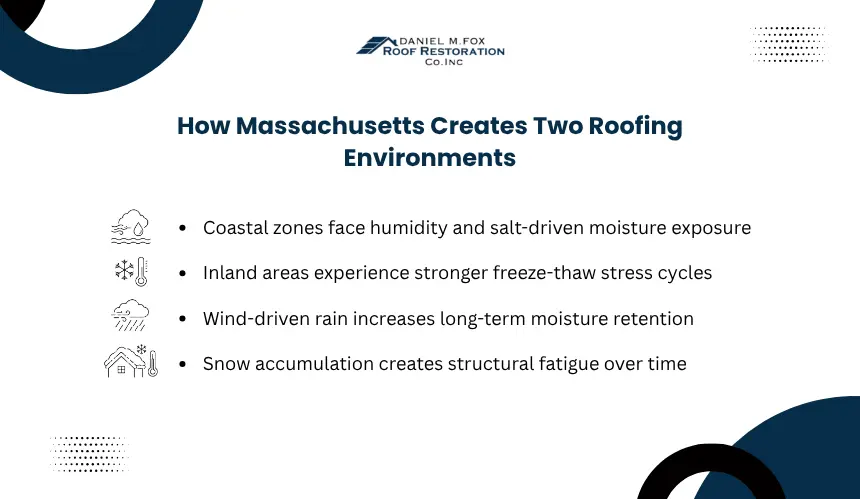
Massachusetts presents two materially different roofing climates due to its proximity to the Atlantic Ocean and localized microclimate variations across the Greater Boston region. These differences directly influence how roofing systems age, fail, and respond to environmental stress.
In eastern and urban-adjacent areas such as Dedham, Brookline, Cambridge, Brighton, and Watertown, roofs are influenced by coastal weather patterns despite not sitting directly on the shoreline. Atlantic-driven air masses carry moisture and trace salt particles inland, especially during storms and humid summer periods.
This results in elevated humidity levels, slower drying cycles, and increased exposure to wind-driven rain. Over time, this promotes surface moisture retention, biological growth, and gradual degradation of protective roofing layers.
In contrast, slightly inland and elevated areas such as Concord, Weston, Wayland, and Winchester experience more pronounced temperature variability. These locations are less affected by salt exposure but face stronger seasonal transitions.
During winter, repeated freeze-thaw cycles create internal stress within roofing materials as trapped moisture expands and contracts. Snow tends to remain longer on roof surfaces in these zones, increasing load duration and the risk of structural fatigue.
These environmental drivers create two distinct weathering pathways within the same regional cluster. Roofs in moisture-influenced zones deteriorate through prolonged exposure to humidity and storm-driven moisture, while roofs in inland pockets are affected more by thermal movement and freeze-related stress. This distinction becomes critical when assessing material performance and long-term maintenance strategies.
How Coastal Conditions Accelerate Roof Weathering
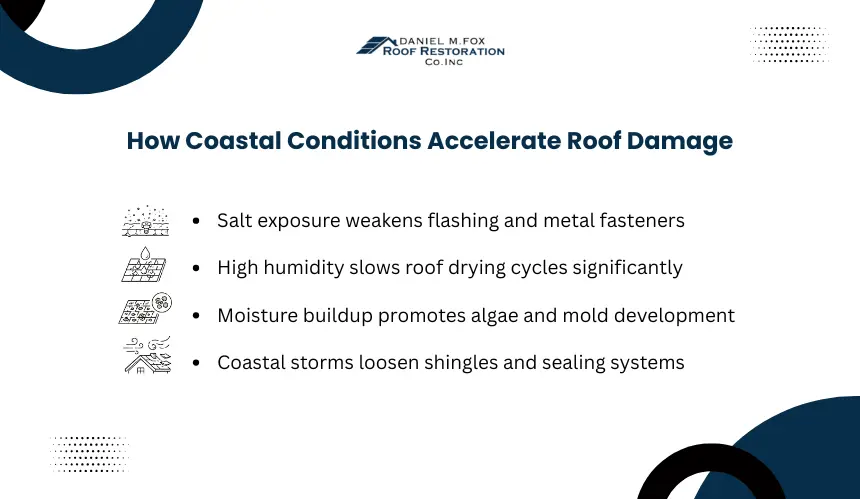
Coastal environments introduce continuous exposure to moisture, salt, and high winds. These factors do not act independently. They compound over time, accelerating surface breakdown and weakening critical roofing components.
How Does Salt Exposure Affect Roofing Materials?
Salt particles carried by ocean air settle on roofing surfaces and dissolve into thin moisture films. This creates a conductive layer that speeds up electrochemical reactions in metals. Flashing, nails, and fasteners begin to corrode earlier, reducing their structural integrity and loosening attachment points.
Protective coatings on metal and asphalt components degrade faster under salt exposure, which shortens the effective lifespan of shingles and increases vulnerability to water intrusion.
Why Does High Humidity Increase Moisture-Related Roof Damage?
Coastal humidity levels remain elevated for longer periods, which limits drying cycles after rain or condensation. Moisture becomes trapped beneath shingles and within underlayment layers, creating conditions for biological growth such as algae and mold.
Organic buildup retains additional moisture, further slowing evaporation and promoting gradual material decay. Over time, this leads to softening of roofing substrates and reduced resistance to external stress.
How Do Coastal Storms And Wind-Driven Rain Impact Roof Durability?
Storm systems along the Massachusetts coast, particularly nor’easters, generate high winds combined with horizontal rain. Wind-driven moisture penetrates beneath shingles at seams and edges, especially where seals have weakened.
Repeated uplift pressure from strong gusts can break adhesive bonds, causing shingles to lift or shift. Once the sealing system is compromised, even moderate weather events can introduce water infiltration, accelerating internal damage across the roofing structure.
How Inland Conditions Create Different Roof Wear Patterns
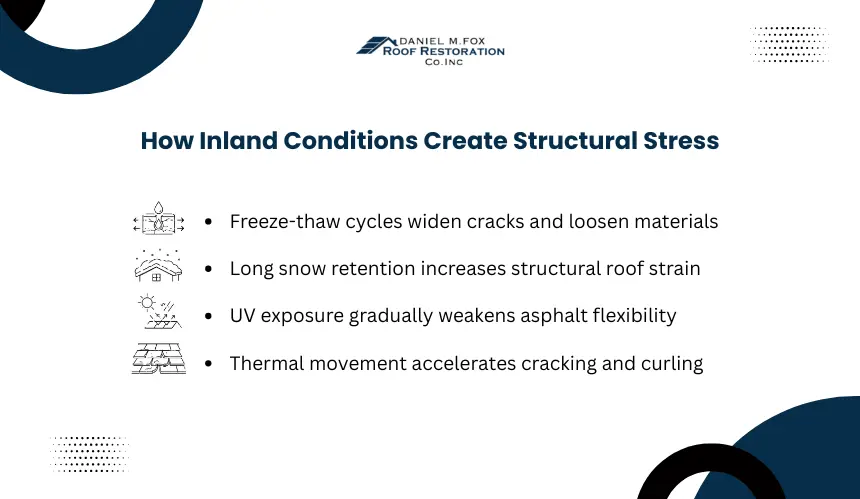
Inland regions experience less chemical exposure but introduce stronger mechanical and thermal stress on roofing systems. These forces act internally within materials, gradually weakening structural integrity rather than accelerating surface-level decay.
How Do Freeze-Thaw Cycles Damage Roofing Systems?
Water enters small cracks, nail penetrations, or gaps beneath shingles during mild conditions. When temperatures drop, this trapped moisture freezes and expands, exerting pressure on surrounding materials.
Repeated expansion and contraction widens these gaps, loosens fasteners, and fracture shingle layers. Over time, this process compromises the roof’s water-shedding capability and increases the likelihood of leaks, especially during late winter and early spring transitions.
How Does Snow Load Affect Roof Structure Over Time?
Inland areas such as Worcester County and the Pioneer Valley often experience prolonged snow accumulation. Unlike coastal regions, where snow may melt faster due to milder temperatures, inland roofs experience sustained weight for extended periods.
This constant load places stress on roof decking, rafters, and connection points. Gradual deflection or weakening can occur, particularly in older structures or roofs not designed for heavy snow retention.
How Do UV Exposure And Temperature Swings Influence Material Aging?
Inland climates typically have lower humidity, allowing surfaces to dry faster but exposing them to more direct UV radiation over time. Ultraviolet rays break down asphalt binders in shingles, causing brittleness and loss of flexibility.
Combined with wider daily temperature fluctuations, materials expand during warmer periods and contract during colder ones. This repeated movement accelerates fatigue, leading to cracking, curling, and reduced resistance to environmental stress.
Material Performance Differences In Coastal Vs. Inland Roofs
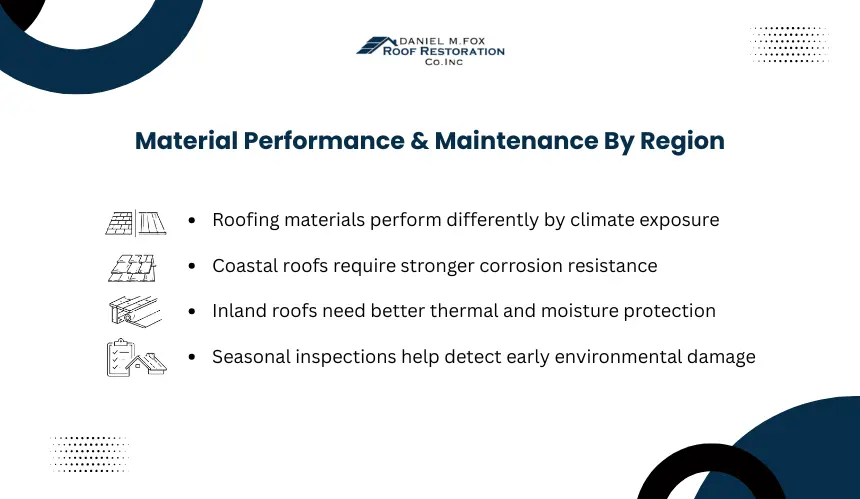
Environmental exposure directly influences how roofing materials behave over time. The same material can fail for different reasons depending on whether it is installed near the coast or further inland, making material selection a performance-driven decision rather than a standard preference.
Asphalt Shingles Vs. Metal Roofing Performance By Region
In moisture-influenced areas like Brighton, Watertown, and Jamaica Plain, asphalt shingle roofing tends to retain surface moisture for longer durations. This accelerates granule loss and weakens the protective outer layer, increasing susceptibility to water penetration. In inland locations such as Winchester and Concord, wider temperature swings lead to gradual brittleness, cracking, and reduced flexibility over time.
Metal roofing performs differently across these zones. In higher humidity environments, it provides strong resistance to water intrusion but requires protective coatings to prevent gradual oxidation. In inland regions, metal systems undergo repeated expansion and contraction due to temperature variation, placing stress on fasteners and seams if not properly engineered.
How Do Slate And Copper Roofs Respond To Massachusetts Conditions?
Slate and copper roofing systems in Greater Boston are commonly installed together across older and high-value properties in areas such as Cambridge, Newton, and Brookline, where architectural consistency and long-term durability are critical. Their performance varies based on how each material interacts with local environmental stress.
Slate roofing offers high structural durability but depends heavily on fastening systems and substrate stability. In moisture-influenced areas, prolonged damp conditions affect fasteners and underlayment layers rather than the slate itself.
In inland locations, repeated freeze-thaw cycles create stress at attachment points, which can lead to gradual displacement if installation precision is not maintained.
Copper roofing performs reliably across both moisture-heavy and inland environments due to its natural corrosion resistance. In areas influenced by coastal weather patterns, it develops a protective patina layer that slows further degradation while adapting to humidity exposure.
However, continuous moisture and storm-driven conditions can accelerate this surface change. In inland settings, copper remains structurally stable but responds to thermal expansion, requiring accurate detailing at seams, joints, and transitions to prevent long-term stress buildup.
How Does Rubber Roofing Perform In Urban And Inland Settings?
Rubber roofing, often used on low-slope sections in areas like Cambridge, Brighton, and Watertown, is highly sensitive to drainage conditions and temperature fluctuation.
In moisture-heavy zones, improper drainage can lead to standing water, which increases membrane wear and seam stress over time. Prolonged exposure to damp conditions can also weaken adhesive bonds if not properly maintained.
In inland areas such as Weston and Wayland, rubber roofing is more affected by thermal movement. Expansion during warmer periods and contraction in colder temperatures can place stress on seams and flashing details.
Proper installation and flexibility in the membrane system are critical to maintaining long-term performance under these conditions.
Flashing, Fasteners, And Underlayment Durability
Across Massachusetts, supporting components often determine the overall lifespan of a roofing system. In moisture-influenced areas like Brookline and Newton, flashing and fasteners remain exposed to prolonged damp conditions, increasing the risk of corrosion and joint failure. Using corrosion-resistant materials becomes essential to maintain structural reliability.
In inland towns such as Concord and Winchester, underlayment systems carry greater importance. Ice and water barriers are critical for managing freeze-thaw cycles and preventing leakage from ice dam formation. The performance focus shifts from corrosion resistance to moisture control and thermal resilience within the roofing assembly.
Lifespan Variations Based On Location
Roof lifespan varies across these Massachusetts areas due to the dominant environmental stress factor. Properties in moisture-heavy environments such as Cambridge, Brookline, and Watertown often experience faster surface-level degradation, leading to more frequent maintenance cycles.
Inland properties in Concord, Weston, and Wayland may retain surface integrity longer but develop structural wear from repeated thermal stress and seasonal expansion.
This results in different replacement timelines and maintenance strategies, even within a relatively small geographic region. Evaluating roofing performance through a localized lens allows for more accurate planning and better long-term outcomes.
Practical Roof Maintenance And Inspection Differences By Region
Maintenance requirements vary across Massachusetts because the dominant stress factor differs by location. Effective inspection planning depends on identifying whether moisture exposure or thermal stress is the primary driver of wear.
What Roof Maintenance Priorities Apply To Moisture-Influenced Areas?
Roofs exposed to persistent humidity and frequent rainfall require consistent surface management. Accumulated debris and organic growth, such as algae or moss, trap moisture against the roofing surface, which accelerates material breakdown.
Cleaning roof surfaces, maintaining clear drainage paths, and monitoring for soft spots or discoloration help preserve the protective outer layers and prevent long-term moisture damage.
What Roof Maintenance Priorities Apply To Inland And Temperature-Driven Zones?
In areas where temperature variation is the primary stress factor, maintenance should focus on structural integrity. Small cracks, loose fasteners, and minor gaps can expand during freeze-thaw cycles, leading to larger failures over time.
Monitoring flashing, seams, and underlayment edges is critical, along with ensuring proper attic insulation and ventilation to reduce the risk of ice dam formation.
When Should Roof Inspections Be Scheduled?
Inspection timing should follow seasonal stress patterns rather than fixed intervals. Roofs exposed to high moisture benefit from inspections after periods of heavy rain or humidity, when surface-related issues are more visible.
In contrast, roofs affected by temperature fluctuations should be assessed after winter, when freeze-thaw damage and structural stress become easier to detect. Aligning inspections with these conditions improves early detection and reduces repair complexity.
As a baseline, roofs should be professionally inspected at least twice per year, with additional checks recommended after major storms or extreme seasonal events.
Roof performance in Massachusetts depends on more than just materials. It requires the right approach for your specific conditions. Daniel Fox Roofing helps homeowners make informed decisions based on real environmental factors, not guesswork. Schedule a professional roof evaluation to identify early risks, extend lifespan, and ensure your roofing system is built to handle local weather patterns effectively.
Frequently Asked Questions
Can a roof “leak” in winter even if the shingles are still intact?
Yes, because some winter water entry is not caused by missing shingles at all. Condensation from warm interior air, blocked ventilation paths, and ice dam backup can all produce staining that looks like a roof leak. That is why diagnosis should include attic airflow, insulation continuity, and eave conditions, not just the outer roof surface.
Is attic ventilation alone enough to stop moisture and ice-dam problems?
Not usually. Ventilation is one part of the system, but it does not compensate for major air leakage from the living space or weak attic insulation. A durable fix usually combines air sealing, balanced intake and exhaust ventilation, and proper thermal control so the roof deck stays colder and drier in winter.
Are algae-resistant shingles worth considering in humid parts of Massachusetts?
They can be a practical upgrade where roofs stay damp for long periods or receive limited sun exposure. Algae-resistant shingles are designed to reduce black streaking and help preserve curb appeal, which matters when humidity, tree shade, and slower drying cycles increase biological staining risk. They do not solve drainage or ventilation problems, but they can reduce one visible moisture-related issue.
Should a snow-covered roof still be inspected after winter storms?
Yes, but the inspection method may change. When direct walking inspection is unsafe, contractors often rely on ground observation, interior moisture mapping, attic review, and thermal scanning until the roof surface clears. Waiting too long can hide active water entry, wet insulation, or deck damage that becomes more expensive once temperatures rise.
Does copper patina mean the roof is failing?
Not by itself. Patina is usually a normal oxidation layer that helps protect copper from deeper corrosion. The real concern is not the color shift but whether seams, fasteners, transitions, and flashing details remain secure as the material expands and contracts over time. Performance should be judged by detailing the condition, not appearance alone.
Will insurance cover roof weathering if the damage builds up slowly over time?
Often, no. Insurance commonly responds more clearly to sudden storm damage than to gradual deterioration, deferred maintenance, algae staining, or age-related wear. After a severe event, homeowners should document missing shingles, damaged flashing, and visible intrusion quickly, because delayed reporting can make cause attribution harder during the claims process.